
A market forecast, a bottle made partly of old bottles, a trade fight over brake drums and a stack of recalls. Here is what this week in brakes means for anyone who owns a master cylinder.
It is 6:40 on a Monday morning and you are doing what you have done ten thousand times: foot on the pedal, engine on, gear selected. The pedal drops about as far as it always does. The car does exactly what it is told. You do not think about any of it, and that is the whole point.
Behind that forgettable moment sits a liquid that was poured into the car at the factory, has been quietly drinking moisture from the air ever since, and has not crossed your mind in two years. This week, a surprising number of people in the brake industry thought about it. We read through the trade coverage so you do not have to, and sorted it by what it means whether you drive one car, service twenty or manage two hundred. Along the way we will point out where the brake fluid shelf at Sauto Mobils fits.
01 · The number: a $2.7 billion fluid
Start with the headline everyone can quote. The Business Research Company reckons the global brake fluid market will grow from $2.53 billion in 2025 to $2.7 billion in 2026, then reach $3.45 billion by 2030 at roughly 6.3 percent a year, according to its release carried by EIN Presswire. The explanation is simple. More hydraulic braking systems on new vehicles means more factory fill, and the same vehicles need fluid again later as routine maintenance.
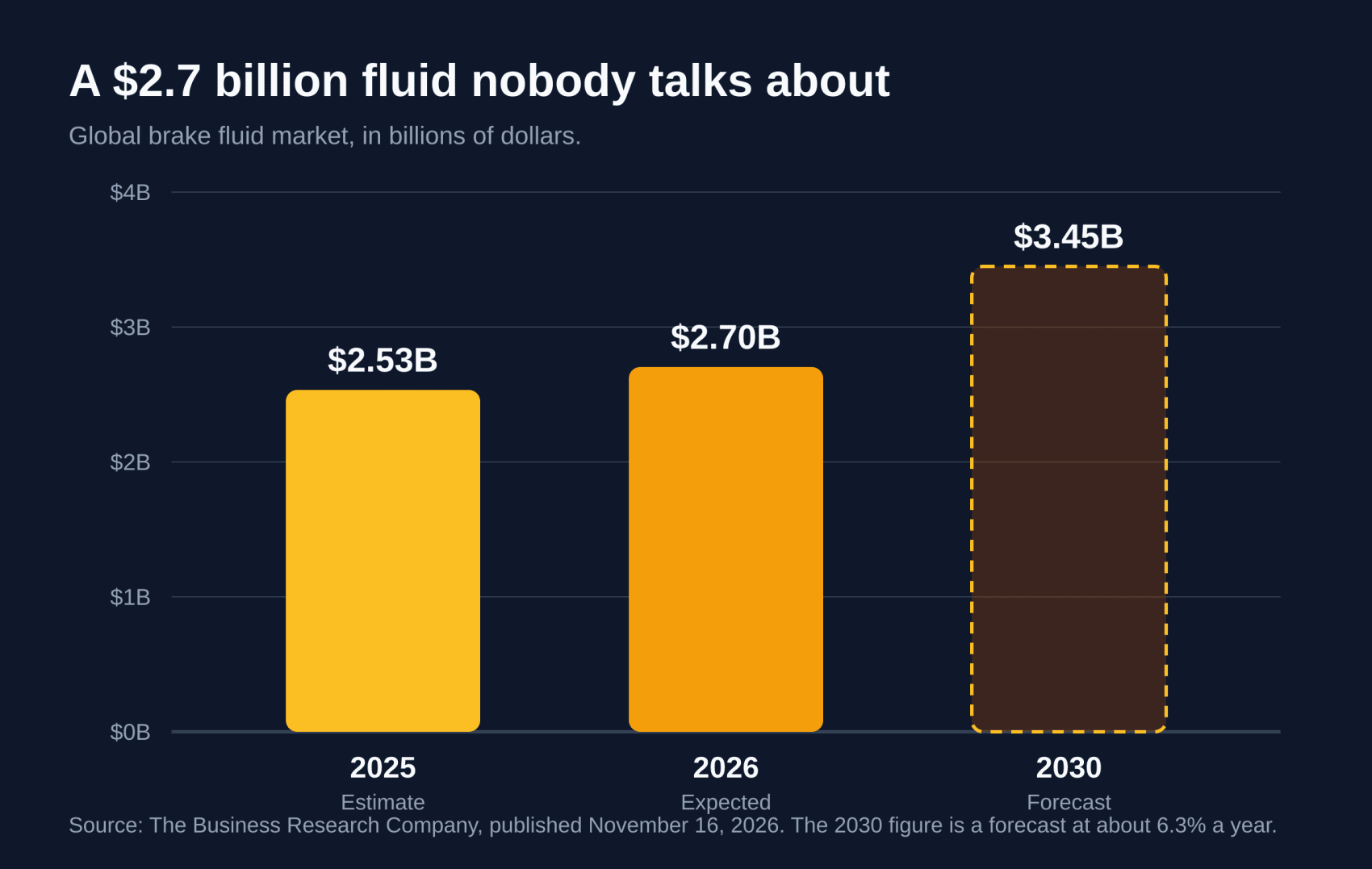
Take those figures the way you would take any forecast from a market-research publisher: as a direction, not a promise. The direction is easy to believe, though. S&P Global Mobility puts the average vehicle on U.S. roads at nearly thirteen years old, and older cars are exactly the ones that need hoses, calipers and fluid looked at.
A fluid meant to be replaced every couple of years is a repeat customer disguised as a leftover.
That is the quiet appeal of brake fluid for a supplier. The brake fluid category at Sauto Mobils runs 21 listings, from a three-dollar can for the glovebox to gallon and 5-liter containers for shops. It is a fair picture of how demand actually splits: plenty of small purchases, and a smaller number of big, regular ones.
02 · The warning: brakes got complicated, so the fluid got picky
Germany’s Liqui Moly used its November partner newsletter to make an argument that deserves more attention than it will get. In its piece on brake fluid service, the company says the job is now more important than ever, because brake systems are getting more complex and the requirements for fluids and replacement specifications are rising with them. Read it with the usual caveat: the same article promotes the company’s Brake Fluid Tronic service machine, so it has something to sell. The underlying point still holds.
Think about what sits between your pedal and your wheels now. ABS and stability-control valve blocks full of tiny passages. Electronic parking brakes. On hybrids and EVs, regenerative braking that can leave the friction brakes idle for long stretches. Fluid that has absorbed water does not care how clever the electronics are. Water lowers its boiling point and invites corrosion, and a corroded valve in a modern hydraulic unit is a very different bill from a corroded caliper bolt.
The numbers worth knowing. From AMSOIL’s comparison: DOT 3 boils at about 401°F dry and 284°F wet. DOT 4 is 446°F and 311°F. DOT 5.1 and DOT 5 are both listed at 500°F and 356°F. DOT 3, 4 and 5.1 are glycol-based and compatible with each other. DOT 5 is silicone-based and is not. SlashGear and Haynes cover the same ground in plain language.
That is why “just any DOT 4” is a worse answer than it used to be. Some vehicles want a low-viscosity formula, and Ford is one of the makers that does. The Motorcraft 16 oz DOT 4 LV at $13.49 is listed as an ether-based fluid recommended by Ford for Ford, Lincoln and Mercury vehicles. European cars often specify DOT 4 too, and the Pentosin 1 liter DOT 4 at $10.49 (there is a second 1-liter listing at $12.99) is a familiar choice there. The rule has not changed: the reservoir cap and the manual decide.
Pick your fluid in thirty seconds
My cap says DOT 3. Eight choices, from glovebox to workshop. For small top-offs, the Prestone 12 oz is $3.00 and the Motorcraft 12 oz is $7.50 for Ford owners who like matching the factory badge. The 32-ounce size is where most single-car jobs start: Pure Guard at $4.25, Prestone at $5.00 and Wagner at $6.50. There is also a Lucas Oil quart at $6.25, and for shops a Pure Guard gallon at $14.99 and a Prestone gallon at $15.99.
My cap says DOT 4. Cans first: BrakeBest 12 oz at $3.50 and Prestone 12 oz at $4.00. For a proper flush, the BrakeBest quart is $6.25 and the Prestone 32 oz is $6.50. European-car owners can look at the Pentosin 1 liter and the Pentosin 5 liter at $33.49, which works out to about $6.70 a liter against $10.49 for the single liter. Ford drivers whose manual asks for low viscosity have the Motorcraft DOT 4 LV.
I service several different cars. Two bottles are labeled for more than one rating: the Valvoline 32 oz DOT 3 / DOT 4 at $7.00 and the Bosch 32 oz DOT 3 / DOT 4 / DOT 5.1 at $9.99. Read the label for exactly which standards each meets.
I tow, haul or brake hard. If your manual allows it, Prestone DOT 5.1 at $8.49 gives more thermal headroom while staying compatible with DOT 3 and DOT 4 systems. It is glycol-based, so it is not the same thing as DOT 5.
My bike or classic calls for silicone (DOT 5). The two silicone fluids are the Motor Medic 11 oz at $8.00 and the Motor Medic quart at $16.50. Use them only in systems built or converted for silicone, and never top off a glycol system with them.
03 · The bottle that came back
Ahead of Automechanika Frankfurt this year, ZF Aftermarket announced what it called a market first: TRW DOT 4 Brake Fluid ESP Recycled, made with 60 percent post-consumer recycled material. ZF says it is engineered to meet the same quality and safety standards as conventional fluid, with component-level compliance benchmarked against ISO 4925. The same coverage notes that Brembo was bringing an expanded lower-emission fluid and pad lineup to the show, and that ZF validated TRW pads and discs against Euro 7 brake-particle limits that the report says take effect in November 2026. The announcement is a few months old, but it is the most notable fluid launch we found.
Two honest reactions. First, a bottle made of old bottles will only matter if buyers can trust it, and for brake fluid trust means a spec sheet, a DOT rating and a boiling point, not a green label. Second, we have not found it on U.S. shelves, so for now it is a signal, not an option. The shelf at Sauto Mobils today is conventional fluid from Prestone, BrakeBest, Pentosin and Motorcraft. Watch the recycled-content story, but remember what counts when the cap comes off: the fluid in your hand has to match the rating on your reservoir.
04 · The paperwork: duties, drums and margins
Not all of this week’s brake news fits in a bottle. On November 12, The BRAKE Report carried a preliminary Commerce finding that Chinese CGI brake drums circumvent existing duties, a ruling aimed at commercial-vehicle parts. Elsewhere the supplier numbers read like a mixed week. Akebono’s first-half operating profit rose 13.8 percent even as sales fell, and Frasle Mobility’s third-quarter revenue slipped 1.9 percent while gross profit rose. Cobreq, TMD Friction’s Brazilian brand, marked 65 years.
The common thread is margin pressure and duty uncertainty on hardware, which is exactly where a fluid looks refreshingly simple. It is one of the cheapest parts of a brake job, the part most likely to be skipped, and skipping it is how expensive parts start to fail. Fleets feel this first, and they tend to buy by the gallon. The Pure Guard gallon at $14.99 and the Prestone gallon at $15.99 work out to roughly 12 to 12.5 cents an ounce, about half the per-ounce price of a 12-ounce can.
For comparison, a check of big-box retail this month put a 32-ounce Prestone DOT 3 at roughly $9 to $10, against $5.00 for the 32-ounce Prestone at Sauto Mobils. Retail prices move, so check before you quote anyone. The wholesale model has a catch worth knowing: low-priced items carry a $500 minimum cart, which you can reach by mixing categories, as explained on the payment and ordering page. Volume tiers are shown on each listing, and the bulk pricing page covers the program for business accounts.
05 · The ones that came back to the dealer
Three brake-related recalls crossed the trade desks this week, and they are a useful reminder that “a brake problem” covers a lot of ground. According to The BRAKE Report’s recall monitor, Chery is recalling 3,474 Tiggo 8 Pro Max vehicles over a brake pipe leak risk. Acura’s ZDX recall has expanded to 14,648 EVs over brake software. Mitsubishi Fuso is recalling 3,115 eCanter trucks over a parking brake warning lamp.
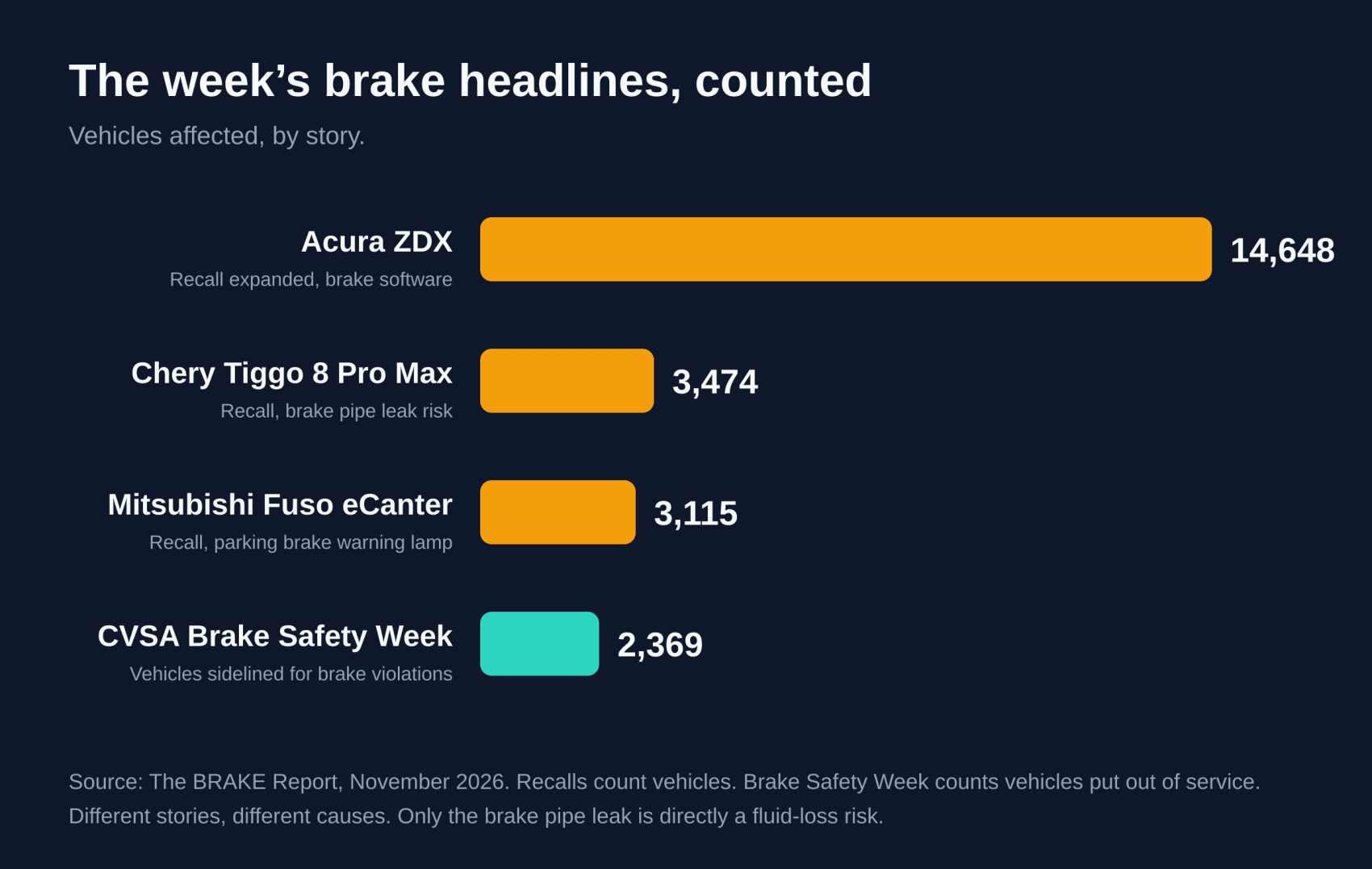
Only the first of those is a fluid story, and it shows why fluid level matters: a leak announces itself as a reservoir that keeps dropping. The software and warning-lamp recalls are reminders in the other direction. Not every brake problem is a fluid problem, and a dash light or a soft pedal deserves a proper diagnosis. Enforcement tells a similar tale. The same site reports that CVSA’s 2026 Brake Safety Week sidelined 2,369 vehicles for brake violations, and CVSA is where fleets go for the inspection side of the story.
A five-minute driveway check
With the car level, look at the reservoir. The level should sit between the MIN and MAX marks.
Look at the color. Fresh fluid is typically clear to amber and darkens with age.
Press the pedal. A soft, spongy or slowly sinking pedal is the classic first warning, as SlashGear points out.
Check each wheel and the lines for wet spots or crusty residue.
Check the dash for brake or ABS lights.
Enter your VIN on NHTSA’s recall lookup.
Most guidance, including J.D. Power’s, lands on a change every two years or so, and Brake & Front End calls two years a good preventive step against fluid boil and internal corrosion. Your manual has the final word.
06 · The new tools on the bench
The hardware news was upbeat. At EICMA, J.JUAN unveiled a bleed quick connector for OE brake lines, the kind of small invention that makes a flush less of a chore. Bendix launched its iTABS X trailer ABS with CAN diagnostics. Apec added 16 new parts to its red braking range, EBC added a Mazda RX-7 big brake kit and Alfa Giulia Quadrifoglio discs, and AP Racing is supplying brake packages for every NASCAR Cup Series car. ATE marked 120 years with a list of five aftermarket trends for workshops. All of it sits on The BRAKE Report’s news page if you want the originals.
The practical takeaway for anyone who does their own work: bleeding is getting easier, and fresh fluid is still the cheapest upgrade a brake system can get. A proper flush pushes new fluid through each wheel, farthest from the master cylinder first, while the reservoir stays topped up. Topping off alone does not replace what is sitting in the calipers. A single-car flush often needs more than a small can, which is why the 32-ounce bottles above are where most people start.
07 · Ask the bench
How often should I change brake fluid? Commonly every two years or about 20,000 miles, or as your manual says. Heavy braking, towing and humid climates all argue for sooner.
Can I mix DOT 3 and DOT 4? Both are glycol-based and compatible, but mixing drags the higher-rated fluid down to the weaker one’s level. A full flush is the cleaner route. Never mix silicone DOT 5 with glycol fluids.
Is DOT 5.1 the same as DOT 5? No. DOT 5.1 is glycol-based and mixes with DOT 3 and DOT 4. DOT 5 is silicone-based and does not. Upgrading from DOT 3 or 4 to 5.1 is generally fine where the manual allows. Going to DOT 5 is a different project entirely.
What does “LV” mean on a DOT 4 bottle? Low viscosity. It is a DOT 4 formulation some manufacturers specify, and Ford is one of them. Use it only where your manual calls for it.
Does recycled brake fluid work the same? ZF says its recycled TRW DOT 4 meets the same standards as conventional fluid. We have not seen it sold in the U.S., so the real test will be independent specs and boiling-point data once it arrives.
My pedal feels spongy. What now? Air or moisture in the lines is the usual suspect, but a leak or worn parts can cause the same thing. Check the reservoir level, look for wet spots and get it inspected soon. Brakes are not the place to wait and see.
08 · Buying for a shop or a fleet
If you keep a stockroom, the terms matter as much as the price, so here they are in one place. Low-priced items carry a $500 minimum cart that can mix oil, coolant, transmission fluid and brake fluid. Engines carry a $1,000 minimum. Shipping options and timelines are on the shipping and delivery page, with heavier items quoted individually. The returns and warranty page describes a 30-day window for eligible, unused items, and it lists hazardous materials among the exclusions, so ask about brake fluid before you order. The team is in Little Rock, Arkansas, and you can reach them at +1 (409) 797-7523 or [email protected]. Start with the brake fluid category or the full product catalog.
So go back to that Monday morning. Foot on the pedal, engine on. Tomorrow, take half a minute to look at the reservoir while the hood is up. It is a small act of attention toward the part of the car you most want to stay boring.
Sources