
Mobil 1 Synthetic Oil: Grades, Prices & Where to Buy

Ask ten mechanics which synthetic oil to buy and at least four will say Mobil 1 before you finish the question. The brand has been a default answer for decades, and plenty of drivers have a loyalty to it that borders on superstition. What most shoppers don’t have is a clear map of the lineup, which is a problem, because “Mobil 1” is not one oil. It’s a family of more than a dozen formulas, each aimed at a different engine, mileage and driving style.
This guide is that map. It covers the grades people search for most, explains which line fits which driver, walks through current pricing and compares Mobil 1 with its biggest rivals. Everything mentioned is available at Sauto Mobils, where you can browse the full Mobil 1 selection in the motor oil category or compare brands in the product catalog.
Why drivers pay more for Mobil 1 (and when it’s worth it)
Full synthetic oil is engineered molecule by molecule rather than simply refined from crude, so it behaves more consistently. It flows faster when the engine is cold, which is when most wear happens, and it resists breaking down when the engine is hot. For turbocharged engines, direct-injection engines, hybrids and anything that sits in traffic or tows a load, those traits are the difference between a comfortable service interval and a stressed one.
Is Mobil 1 worth it? For engines that specify synthetic, yes, provided you buy the grade and approvals your manual lists. For a simple older engine on short change intervals, a good conventional or blend oil that meets the spec can be perfectly fine. The brand matters less than the match, which is why the rest of this guide starts with the grade.
Start with the grade, not the brand
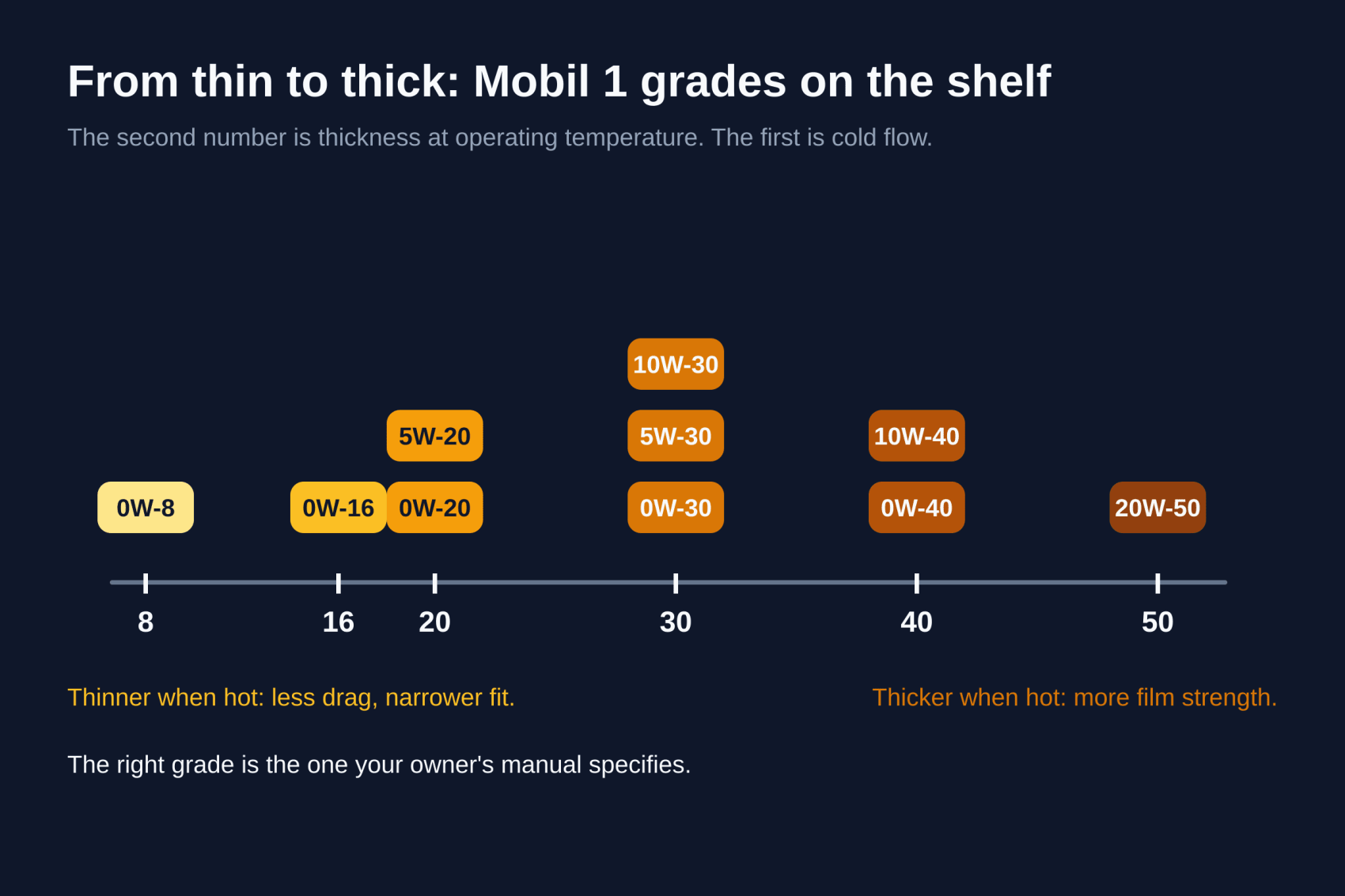
Every oil grade carries two numbers. The first, followed by a W for winter, describes how easily the oil flows when cold, and lower flows faster. The second describes how thick it is at operating temperature. A 0W-20 is thin cold and thin hot. A 10W-40 is thicker at both ends. Neither is better. The right one is whatever your owner’s manual names, and the oil filler cap often prints it too.
Mobil sells its synthetics in the grades most engines actually use, and a handful dominate searches.
Mobil 1 5W-30: the classic
If there’s a default engine oil in America, it’s 5W-30, and Mobil 1 makes several ways to buy it. The straightforward choice is the Mobil 1 Advanced Full Synthetic 5W-30 in a 5-quart jug at $17.98, which is about $3.60 a quart. ExxonMobil also notes that its Advanced Fuel Economy 0W-30 is recommended for 0W-30, 5W-30 and 10W-30 applications, and that formula is available as a budget-friendly 0W-30 quart at $5.00, the cheapest single bottle in the family. Engines with a few more miles can step up to the Mobil 1 High Mileage 5W-30 at $18.48, which we’ll cover below.
Mobil 1 0W-20: the modern default
Automakers have spent the last decade moving to thinner oil because it cuts internal friction and helps fuel economy, and 0W-20 is now the factory fill for a huge share of modern vehicles. The Mobil 1 Advanced Fuel Economy 0W-20 in a 5-quart jug is $17.98, and there’s a 1-quart bottle at $6.00 that belongs in the trunk for top-offs. The jug saves $2.40 per quart, so anyone changing their own oil should buy it. Mobil also recommends this formula for both 0W-20 and 5W-20 applications, which answers one of the most common shopper questions: yes, 0W-20 is widely used where a manual calls for 5W-20, though your manual has the final word. mobil
Mobil 1 5W-20 and 10W-30: when the manual says so
Engines that specifically list 5W-20 can use the Mobil 1 High Mileage 5W-20, the Extended Performance High Mileage 5W-20 or, for pickups, the Truck & SUV 5W-20 quart. Older engines that still call for a heavier film have the Mobil 1 Advanced Full Synthetic 10W-30 in a 5-quart jug and a 10W-30 quart, both at the same $6.00 and $17.98 pricing as the rest of the standard line, plus the High Mileage 10W-30 and High Mileage 10W-40 for engines that need extra protection.
Mobil 1 0W-40: the thicker option with a cold-start advantage
Some engines, especially European and performance models, want an oil that is thick at operating temperature but still flows easily on a cold start. That’s the job of the Mobil 1 Full Synthetic 0W-40, a $7.00 quart.
Mobil 1 0W-16 and 0W-8: the new thin guard
The thinnest grades are spec-driven, and they exist only because certain engines were built with tolerances tight enough to use them. Mobil 1 0W-16 is aimed at select Honda and Toyota engines that call for it, and it comes in a 1-quart bottle too. The even newer Mobil 1 0W-8 fits the newest engines that list it, with a quart available as well. These are the grades most worth double-checking against your manual, since using a thicker or thinner oil than the engine was designed for can affect efficiency and protection.
High Mileage, Extended Performance or Advanced Fuel Economy?
This is the question that stalls most shoppers at the shelf, because the three lines overlap. A simple way to sort them out is to ask what you want most from the oil.
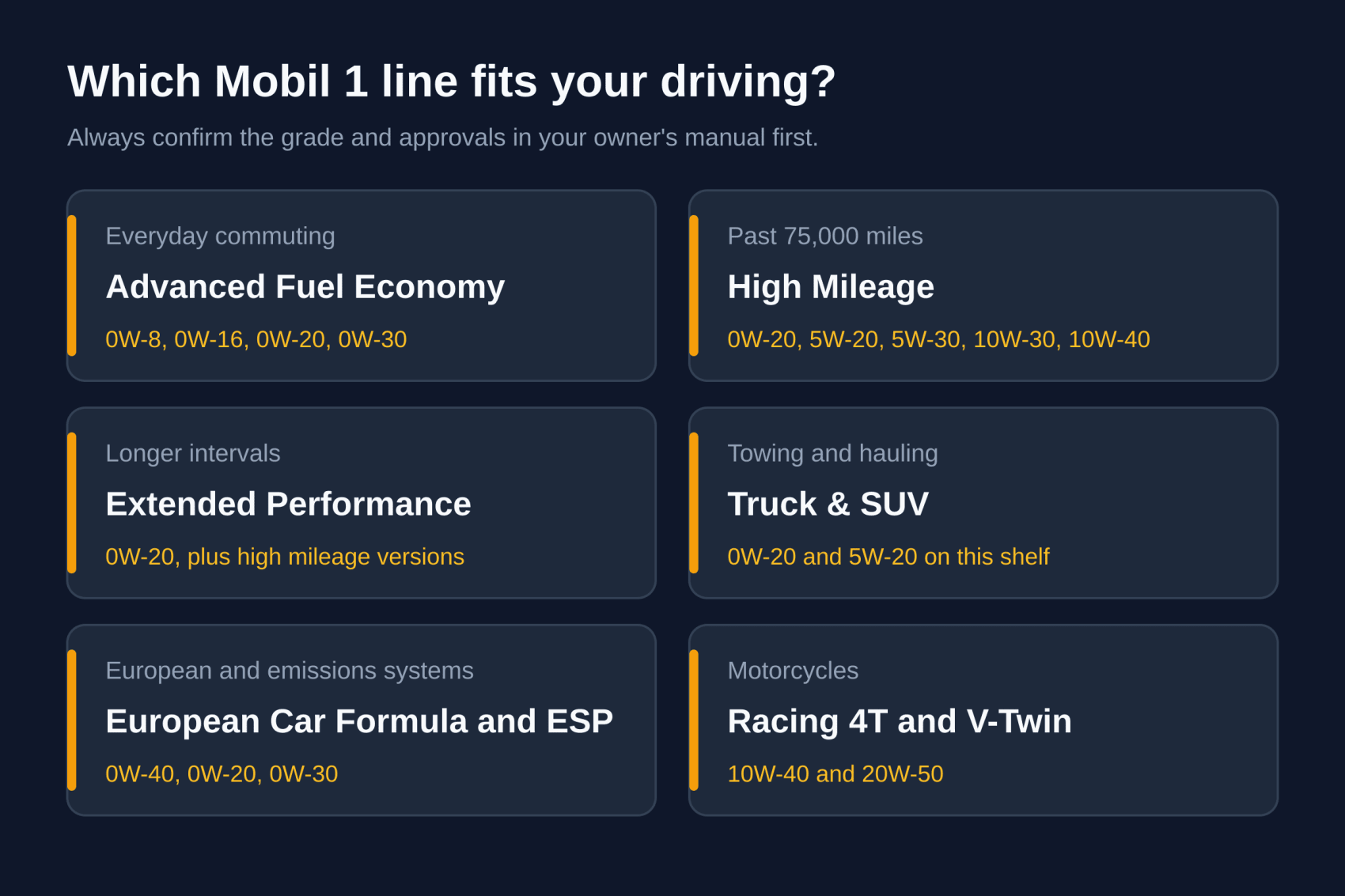
Advanced Fuel Economy is the baseline for modern engines that specify thin synthetics, and it’s what the 0W-16, 0W-20 and 0W-30 options above belong to. If your car is under 75,000 miles and your manual calls for a common grade, this is the sensible starting point.
High Mileage is aimed at engines past the 75,000-mile mark. Mobil describes the line as designed to help extend engine life in vehicles with over 75,000 miles, adding extra seal and wear protection. In 0W-20, there’s the High Mileage 5-quart jug at $18.48 and a quart at $6.25.
Extended Performance is for drivers who want longer intervals between changes. Mobil’s U.S. site says the High Mileage version offers up to 20,000 miles of wear protection, guaranteed. Guarantee terms vary by product and date, so read Mobil’s current conditions before planning around any number. The Extended Performance 0W-20 jug is $18.98, with a quart at $6.50. The version that combines both ideas, Extended Performance High Mileage, comes in 0W-20, 5W-20 and 5W-30 jugs at $19.48 each, with a 0W-20 quart at $6.75.
Trucks, SUVs, European cars and emissions systems
Heavier-duty driving and special emissions equipment get their own formulas, and using the right one matters more than any brand preference.
For gas-powered trucks and SUVs, Mobil 1 Truck & SUV is designed for gas-powered trucks and SUVs, with proven performance towing 10,000 pounds. The 0W-20 jug is $18.48 and the 0W-20 quart is $6.25.
Vehicles with particulate filters and other emissions equipment may need a low-ash formula, which is what Mobil 1 ESP is built for. Mobil says its Emission System Protection is meant to prolong the life of emission reduction systems in diesel and gasoline engines. Use it only if your manual calls for it. The ESP 0W-30 jug is $17.98, with a 0W-30 quart at $6.00 and an ESP 0W-20 quart at $7.00.
European engines often want a higher-viscosity synthetic with a long list of manufacturer approvals, which is the role of the Mobil 1 European Car Formula 0W-40. It’s available as a 5-quart jug at $17.98 and a 1-quart bottle at $6.00. Approvals vary, so match the codes your manual lists (ACEA, BMW, Mercedes-Benz, Porsche, VW) to the label on the bottle.
Motorcycles and the rest of the driveline
Mobil 1 goes well beyond passenger-car engine oil. Riders can choose the Mobil 1 Racing 4T 10W-40 or the Mobil 1 V-Twin 20W-50, each a $6.50 quart. If your bike has a wet clutch, confirm the JASO rating on the label before you pour.
The rest of the vehicle gets attention too. The Mobil 1 Synthetic A/T Fluid for Dexron and Mercon is $6.00 a quart, the Mobil 1 Synthetic Gear Oil 75W-90 is $9.49, and the 13.4-ounce Mobil 1 Synthetic Grease is $5.50. Diesel truck owners should look at Mobil’s heavy-duty family instead, such as Mobil Delvac 1300 Super 15W-40 in a 5-gallon pail or the Delvac Full Synthetic 15W-40 gallon.
What Mobil 1 costs in 2026, and why prices jumped
If synthetic oil feels more expensive than it used to, it is. A major driver is a squeeze on Group III base oil, a key ingredient in many synthetic motor oils. As Axios reported, the lubricant industry relies heavily on imports from the Middle East and Asia-Pacific for Group III base oils. JobbersWorld compared 97 matched products and found prices up 24.2% between February and August 2026, with some of the biggest jumps in five-quart full synthetics. ExxonMobil has said it is working to reformulate products with alternative inputs while maintaining the same high standards. Read the company’s explanation in its lubricant supply viewpoint. Motor oil shortages are starting to appear amid Middle East disruptions +2
The practical lesson is to buy by the jug, not the bottle. A 5-quart Advanced Fuel Economy jug at $17.98 works out to about $3.60 a quart, compared with $6.00 for a single quart. Extended Performance drops from $6.50 to about $3.80 a quart, High Mileage from $6.25 to about $3.70, and Extended Performance High Mileage from $6.75 to about $3.90. For an engine that takes four to six quarts, an oil change costs roughly $18 to $22 in oil, plus a filter. Because formulations can change within approved ranges, always check the API and OEM approvals printed on the bottle each time you buy.
Mobil 1 vs Castrol, Pennzoil and Valvoline
Shoppers rarely buy in a vacuum, so here’s a quick comparison of the same grade across brands. The honest conclusion hasn’t changed in years: when the grade and the approvals match your manual, any reputable full synthetic will protect your engine, and the differences are about formulation details, available variations and price.
For 0W-20, the closest rivals are the Castrol Edge 0W-20 and the Pennzoil Platinum 0W-20. For 5W-30, there’s the Castrol Edge 5W-30 5-quart and the Valvoline SynPower 5W-30 5-quart at $18.50. Mobil 1’s edge in this matchup is range: few brands offer as many tailored versions, from High Mileage to Truck & SUV to ESP.
How to buy Mobil 1 online at wholesale prices
Sauto Mobils is built around buyers who order in volume, and the terms are written down in plain English. Low-priced items such as motor oil carry a $500 minimum cart total, but you can mix products to reach it, which is exactly how shops, fleets and enthusiasts tend to order. The payment and ordering page explains the rule. Volume discounts appear on each listing. For example, the 1-quart Mobil 1 0W-16 ships in cases of 6 or 12, reaches the minimum at 84 quarts, and drops to 5%, 10% and 15% off at 126, 168 and 252 quarts. Tiers vary by product, and the bulk pricing page describes how the program works.
Logistics are spelled out as well. The shipping and delivery page covers options and timelines, and the returns and warranty page describes the 30-day return window. That policy lists hazardous materials among non-returnable items, so confirm how it applies to oil before you order. The team is based in Little Rock, Arkansas, so if you’re searching for Mobil 1 near you in the area, ask about local pickup.
“Their selection of Mobil 1, Castrol, and other top-tier oils is unmatched.”
Lisa Chen, Performance Enthusiast, Austin, TX
“Bulk orders are easy and always on time. Sauto Mobils is my go-to.”
Pedro Alvarez, Delivery Fleet Manager, El Paso, TX
Mobil 1 questions, answered
Is Mobil 1 worth the money?
For engines that specify full synthetic, or that run hot, tow or sit in heavy traffic, yes. For simple engines on short intervals, an oil that meets the spec is enough. Your manual decides.
Which Mobil 1 is best for high mileage engines?
Mobil 1 High Mileage and Extended Performance High Mileage are built for vehicles past 75,000 miles. Choose the grade your manual lists.
Can I use Mobil 1 0W-20 instead of 5W-20?
ExxonMobil recommends its Advanced Fuel Economy 0W-20 for both 0W-20 and 5W-20 applications, but confirm with your manual.
What’s the difference between Mobil 1 0W-16 and 0W-20?
0W-16 is thinner at operating temperature and fits a narrow group of engines, mainly select Toyota and Honda models. Don’t swap them unless your manual allows it.
How often should I change Mobil 1?
Follow your owner’s manual or oil life monitor. Many engines on full synthetic go 5,000 to 10,000 miles between changes, and severe driving shortens that. Extended-interval claims depend on the specific product and Mobil’s guarantee terms.
What is Mobil 1 ESP for?
It’s a low-ash formula for vehicles that call for it, designed to help protect emission systems.
Is Mobil 1 better than Castrol or Pennzoil?
When the grade and approvals match, they’re all strong choices. The right viscosity and the right specification matter more than the logo.
Can I use Mobil 1 in a motorcycle?
Use the motorcycle-specific Racing 4T or V-Twin, and check the JASO rating if your bike has a wet clutch.
Why is synthetic oil more expensive in 2026?
A supply squeeze on Group III base oil has pushed up costs across the industry. Buying jugs instead of single quarts is the easiest way to soften the impact.
Can I buy Mobil 1 in bulk?
Yes. Sauto Mobils offers case packs and volume tiers on many listings, subject to a $500 minimum cart for low-priced items.
To conclude,
Choosing a Mobil 1 comes down to three steps. Read the manual and match the grade, pick the line that fits your mileage and how you drive, then buy the size that fits your budget. When you’re ready to order, browse the full Sauto Mobils motor oil category, compare options in the product catalog, and add what you need to your cart.
Sources