
Base Oil Supply News: Mississauga Refinery, Castrol, PC-12
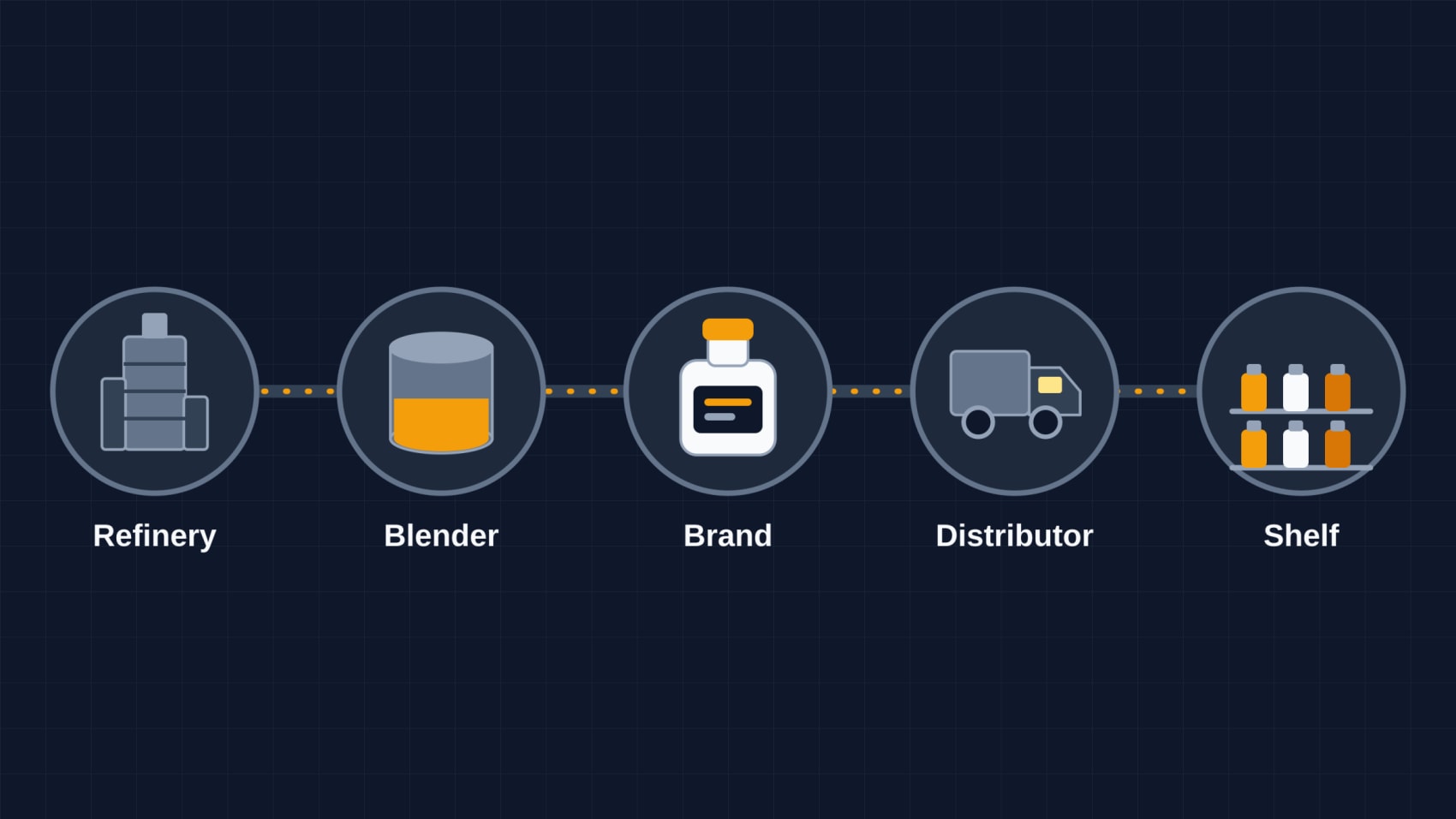
Pick up a quart of motor oil. It weighs about as much as a bag of flour, it cost less than lunch, and it has been through more hands than most things you’ll buy this week. Somebody refined the base oil. Somebody else blended it with additives. A brand put its name on the bottle, a distributor put the bottle on a truck, and a shop or a driver finally poured it into an engine.
This was a loud week for every one of those hands. A union is fighting to keep Canada’s last large base oil refinery open. Castrol has new owners and a new marine distributor. Distributors are being bought, a new heavy-duty oil category is weeks from launch, and prices that spiked this spring look like they’ve stopped climbing. So let’s do something different with the news and follow a single quart from the ground up, stopping where each story happens. At each stop, we’ll point out where the shelf at Sauto Mobils fits.
Base oil in sixty seconds. Motor oil is mostly base oil plus additives. Base oils come in groups. Groups I and II are conventional, crude-derived stocks. Group III is more highly refined, and the Independent Lubricant Manufacturers Association calls it the backbone of modern full synthetic oils. When Group III gets scarce, the oils that depend on it feel it first. Read ILMA’s explanation of why lubricant prices haven’t fallen for the long version.
Stop one: the refinery
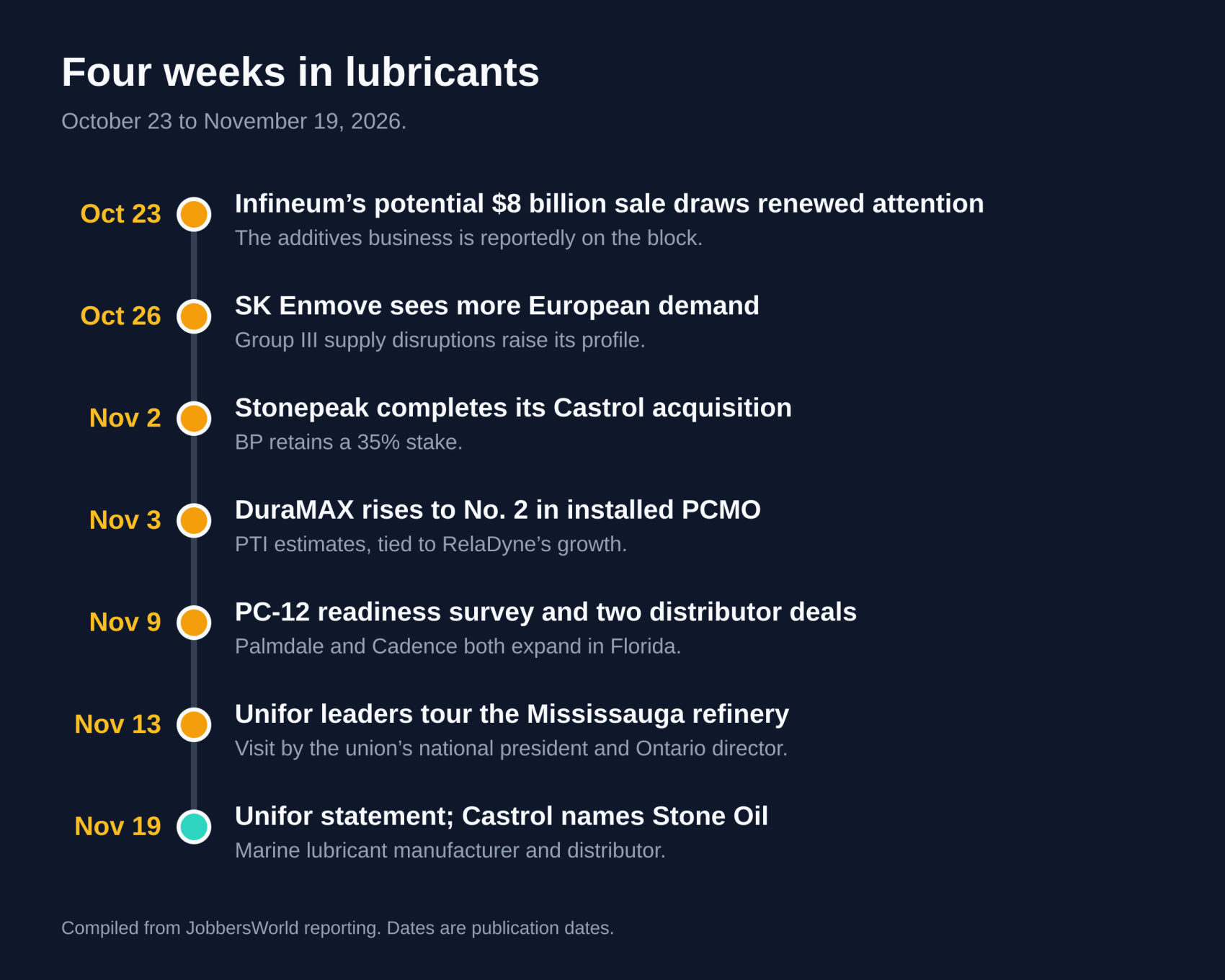
Today’s headline comes from here. On November 19, Unifor, Canada’s largest private-sector union, renewed its call for government action over HF Sinclair’s plan to retire its base oil refining assets in Mississauga, Ontario, in 2027. The statement followed a November 13 visit to the plant by Unifor National President Lana Payne and Ontario Regional Director Samia Hashi.
The numbers behind the fight, as JobbersWorld reports them:
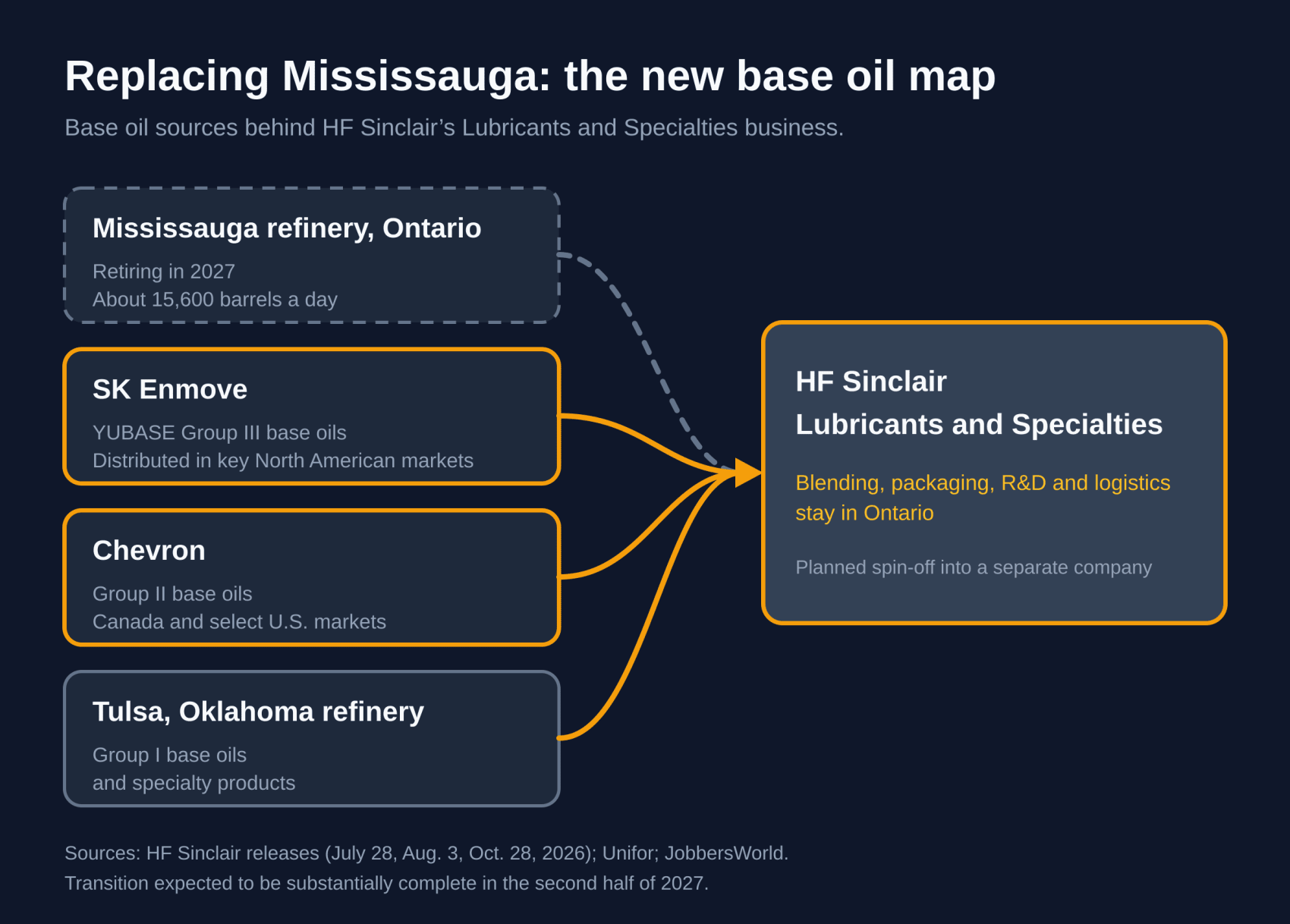
Unifor says the facility is Canada’s only large-scale base oil refinery, processing about 15,600 barrels a day.
About 150 of its members face layoffs.
Through its Keep Canada Refining campaign, the union wants the plant designated critical infrastructure, and it wants the federal and Ontario governments to act, including under the Investment Canada Act.
HF Sinclair tells a different story. On July 28, the company announced a strategic transformation that includes spinning off its Lubricants & Specialties business and retiring the Mississauga refining assets, while keeping blending, packaging, R&D and logistics in Ontario. To fill the gap, it signed long-term supply agreements on August 3 with SK Enmove for Group III base oils and Chevron for Group II. The business also keeps access to Group I base oils and specialty products from its Tulsa, Oklahoma refinery. In its third-quarter results, the company reported $109 million in charges tied to the retirement, and it expects the transition to be substantially complete in the second half of 2027.
Here’s the part that matters beyond Canada. The retirement means more imported base oil at a time when 2026 shortages, especially of Group III, have already caused price increases, product allocations and some formulation changes. The question buyers will ask is whether the replacement supply arrives on time and at a workable price. Nobody can answer that yet, which is exactly why the story has the industry’s attention.
It isn’t an isolated worry. Axios reported in May that Group III prices had climbed above $10 a gallon, and the supply picture still hangs on events far from any shop floor. For the latest headlines on the base oil market itself, Lubes’n’Greases keeps a running base oil report.
What it looks like on the shelf
Whatever refinery the base oil comes from, the thing you buy is a brand, a grade and a specification. Group III is a big part of why thin synthetics have gotten pricier, so it’s worth knowing which of yours lean on it. The Mobil 1 Advanced Fuel Economy 0W-20 at $17.98 for five quarts and the 0W-16 at the same price are the kind of full synthetics the Group III story is about. Sauto Mobils can’t change where the world’s base oil comes from, but its motor oil category lists several brands for each grade, so there’s usually a second option that meets the same spec.
Stop two: the blender and the additive house
A refinery makes base oil. It takes a blender to make that base oil into motor oil, and that means additives: detergents, anti-wear compounds, viscosity improvers. The additive side made its own news this month.
On October 23, JobbersWorld looked at what history reveals about Infineum’s potential sale. The reported valuation is $8 billion, and the piece notes that an earlier sale effort failed. Infineum is a joint venture between Shell and ExxonMobil, so any change in ownership would ripple through two of the biggest names in lubricants. Three days later, JobbersWorld reported that SK Enmove’s European base oil operations are gaining importance, as European customers increasingly reach out amid Group III supply disruptions. SK Enmove is the same Group III supplier HF Sinclair just signed up, so its customer list is getting crowded.
For drivers, none of this changes how you read a bottle. The additive package is why two oils with the same viscosity can still differ, and the approvals on the label are your proof of what’s inside. Sauto Mobils’ engine oil guide is a good place to learn to read them.
Stop three: the brand
Brands changed hands this month too. On November 2, JobbersWorld reported that Stonepeak completed its acquisition of Castrol, with BP retaining a 35 percent stake and a former Shell CEO named chairman. Then, on November 19, Castrol appointed John W. Stone Oil Distributor as a manufacturer and distributor of its marine lubricants. Ownership changes at a big brand rarely change what’s in the bottle overnight, but they’re worth watching for sourcing, pricing and distribution decisions over the next year.
If you buy Castrol, the lineup on the shelf hasn’t changed. The Castrol Edge 0W-20 and Edge 5W-30 jugs are $17.98, the European-spec Edge 5W-40 is $17.48 and the Edge High Mileage 10W-30 is available for older engines. On a tighter budget, the Castrol GTX High Mileage Synthetic Blend 5W-30 is a step down in price. Compare any of them with a rival of the same grade, because the right viscosity and approvals matter more than the logo.
Stop four: the distributor
Between the brand and your driveway sits the distributor, and this is the stop where the news is most about money. On November 9, two Florida distributor deals landed on the same day: Palmdale Oil acquired Tri-County Oil Distributors of Williston, and Cadence Petroleum Group acquired Eli Roberts & Sons, a third-generation fuel and lubricant distributor in Tallahassee founded in 1958. Days earlier, JobbersWorld reported that DuraMAX had risen to No. 2 in installed passenger-car motor oil, according to PTI estimates, a position it tied to RelaDyne’s acquisitions, distribution network and installer support.
The pattern is consolidation. Regional distributors are being absorbed into larger networks, which can mean steadier supply for some customers and fewer choices for others. For a shop or a fleet, the practical question is how many independent sources you have.
That’s the gap a wholesale supplier like Sauto Mobils is built for. Shops, fleets and resellers can buy by the case, the pail and the drum, with the terms written down. Low-priced items carry a $500 minimum cart that can mix categories, as explained on the payment and ordering page. Volume discounts show up on the listings, and the bulk pricing page covers the program for business accounts. Shipping options and timelines are on the shipping and delivery page, and the returns and warranty page lays out the 30-day return window, including the exclusion for hazardous materials, so ask about oil before you order.
Stop five: the specification
Now we reach the part of the journey where the paperwork changes. API’s new heavy-duty engine oil categories, CL-4 and FB-4, are scheduled for first licensing on January 1, 2027, and Shell is preparing its Rotella line for that date, as Heavy Duty Trucking reported. On November 9, JobbersWorld’s PC-12 Readiness Survey found that nearly six in ten respondents are fully or mostly prepared. Unresolved OEM approvals, off-road compatibility concerns and uncertain FB-4 demand could complicate the transition. The trade press has described PC-12 as a technology-aligned upgrade that stays backward compatible, but your engine maker’s guidance is the authority, so check it before moving any engine to a new category.
For fleets and equipment owners, the sensible move is to know what you run now. Sauto Mobils lists the heavy-duty staples across the range: Shell Rotella T6 5W-40 in a 5-gallon pail at $76.00, Rotella T6 15W-40 by the gallon at $17.50, the budget-friendly Rotella Conventional 15W-40 pail at $49.99 and Mobil Delvac 1300 Super 15W-40 at $49.99 for five gallons. They’re current-category oils, so the point of knowing your approvals now is that you’ll recognize the new labels when they arrive.
Stop six: the price tag
Finally, the part everyone feels. Prices rose sharply earlier this year, and there are signs the climb has paused. JobbersWorld’s latest retail analysis found that retail motor oil prices appear to be stabilizing, with 72 of 89 product-family observations unchanged between August and late September. That doesn’t mean prices have come down. Commercial Carrier Journal reported that producer prices for lubricating oil base stocks had jumped 126 percent from January through July, and ILMA expects Group III supply to normalize only in mid to late 2027. On the supply side, Shell partially restarted its Pearl gas-to-liquids plant in Qatar in October, and API extended its emergency licensing so marketers can adjust formulations when ingredients are unavailable. Because formulations can shift within approved ranges, check the API and OEM approvals printed on the bottle each time you buy.
What does a steadier price mean for a buyer? It’s a decent moment to stop reacting and start planning. The simplest savings are in the container size. A 5-quart jug of Advanced Fuel Economy 0W-20 at $17.98 works out to about $3.60 a quart, against $6.00 for a single bottle. For diesel work, the Rotella T6 5W-40 pail runs $15.20 a gallon, roughly 13 percent less per gallon than buying the 1-gallon jug. Prices on all of these can change, so check each listing for the current number.
The quart, once more
So go back to the quart. It started as a refinery decision in Ontario, a sourcing contract in Seoul, an additive deal that may or may not close, a brand with new owners, a distributor that may have just been acquired and a specification that’s about to change. By the time it reaches your hand, all of that has been compressed into a number on the shelf and a grade on the label. The part you control is simple: match the grade and approvals to your manual, pick the size that fits your use, and buy it from a source that spells out its terms. When you’re ready, the Sauto Mobils product catalog is open.
Sources
JobbersWorld: Unifor Steps Up Fight to Save HF Sinclair’s Mississauga Base Oil Refinery
HF Sinclair: Strategic transformation announcement (July 28, 2026)
HF Sinclair: Base oil supply agreements with SK Enmove and Chevron
Commercial Carrier Journal: Fleet maintenance budgets squeezed by spiking lubricant prices