Pennzoil Platinum No Longer dexos Licensed: What It Means
Case file No. 1126. Subject: a jug of motor oil. Complaint: a certification mark that used to be on the label, and may not be on every label anymore.
Here is the short version of the facts. Shell has confirmed that select Pennzoil Platinum and Pennzoil Platinum High Mileage products have moved to alternate formulations, and that the reformulated Platinum is no longer licensed to GM's dexos1 Gen 3 specification. Pennzoil Ultra Platinum was not changed. Shell also says that dexos1 Gen 3 Pennzoil Platinum is still available commercially, just not currently in one-quart or five-quart retail packs, according to GM-Trucks' report on Shell's statement.
So what happened to a badge? Let's go through the evidence, then work out what a driver, a shop or a fleet should do about it. We'll also look at what's on the shelf at Sauto Mobils.
Exhibit A: Shell's own words
The primary document is Shell's Pennzoil 2026 Formulation FAQ, labeled a product information update for October 2026. It's worth reading in full, and here's what it says in plain terms:
To help support product availability, Pennzoil is using alternate formulations for select Pennzoil Platinum and Pennzoil Platinum High Mileage products.
Those formulations now use a blend of gas-to-liquid (GTL) base oil and high-quality non-GTL base oils, and Shell says they continue to meet the claims, specifications and approvals stated on the labels and brand websites.
Pennzoil Ultra Platinum is a different story. Shell says it has not altered those formulations, which continue to contain the same percentage of GTL base oil.
On the dexos question, Shell explains that OEM approvals such as dexos1 Gen 3 can be tied to a specific formulation, meaning a unique combination of base oils and additives in precise ratios. When the formulation changes, the existing license does not necessarily carry over, even if the new product meets API SQ and every other claim on the label.
Shell continues to offer dexos-licensed Pennzoil Ultra Platinum 0W-40 in one-quart, five-quart, drum and bulk formats. GM-Trucks notes that this oil is licensed under dexos R, which matters for owners of recall-remedied 6.2L trucks.
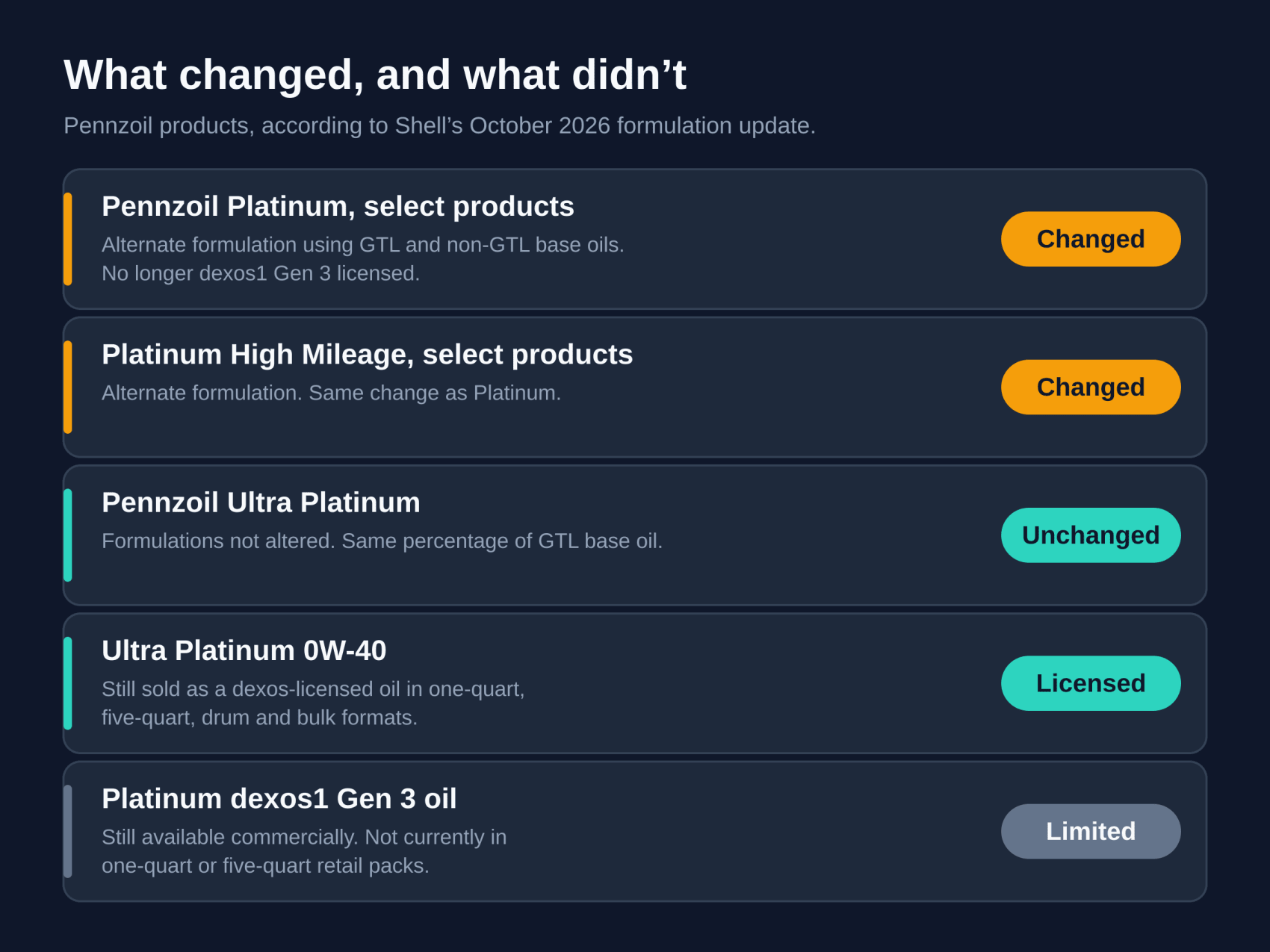
One detail deserves a second look. Shell's wording is careful: "select" products changed, and the license "does not necessarily carry over." Read together with the report that dexos1 Gen 3 Platinum remains available commercially, that leaves room for older-formulation bottles still in the supply chain to carry the license while newer ones don't. Planet X's write-up puts it neatly: the name on a jug of Pennzoil Platinum is no longer a reliable guide to whether the oil is dexos-licensed. That is the single most useful sentence in this whole story.
Exhibit B: How a license vanishes
To understand why this happened, you need to know what dexos is. It's General Motors' proprietary engine oil licensing program, and for gasoline engines it comes in dexos1, currently in its third generation. A dexos1 Gen 3 oil must meet or exceed API SP and ILSAC GF-6 and pass GM's own additional tests. The license belongs to a specific recipe, not to a brand name.
That's the catch. In April, the Independent Lubricant Manufacturers Association asked GM for temporary flexibility, warning that damage to major Group III production in the Middle East and the effective halt of shipping through the Strait of Hormuz had constrained a base oil that underpins most dexos-licensed formulations. According to Fuels & Lubes' report on GM's April 3 response, GM declined to suspend enforcement. It offered a narrower accommodation: it would expedite reviews of alternative base oils and formulations submitted by blenders, with each judged on its own technical merits. ILMA's own summary, on its member advisory page, tells licensees to proceed on the assumption that GM's enforcement practices will stay in place.
The industry has leeway in one place and none in another. API, the body behind the "donut" service mark, approved about 70 products under emergency licensing, while GM offers no comparable program. That comes from JobbersWorld's November 20 report on the dexos strain, which also notes that Shell and Valvoline have both dropped dexos1 approval claims on select oils. In practical terms, an oil can keep its API starburst while losing the GM badge. They're separate certifications, run by separate organizations, with different rules about reformulation.
Valvoline's move is a useful comparison. As Lubes'n'Greases reported, the company is removing dexos labeling from certain full synthetic products sold in bulk, tote and drum containers across the U.S., Mexico and Canada. It says those products remain suitable for most makes and models, including out-of-warranty GM vehicles. Its dexos D products, Advanced Bay Boxes and full synthetics in 5-quart and 1-quart containers stay dexos-approved while supplies last.
Exhibit C: The suspect is a base oil
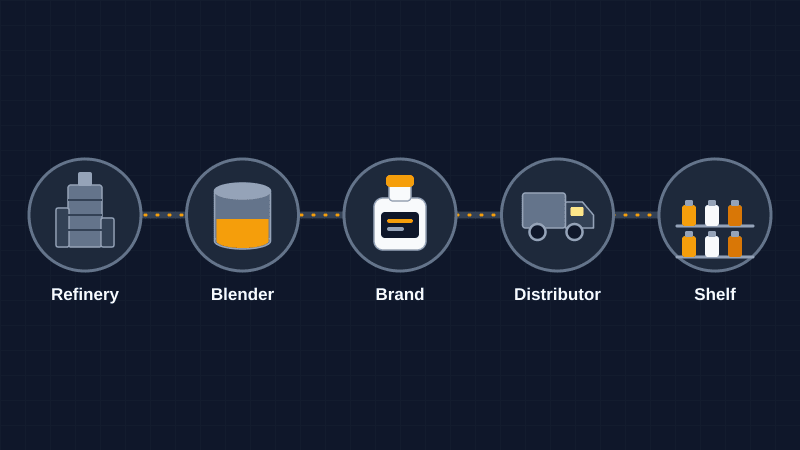
Every thread in this story leads to one ingredient. Pennzoil Platinum and Ultra Platinum are built around base oil that Shell makes from natural gas, using gas-to-liquids technology at its Pearl plant in Qatar. When shipping through the Strait of Hormuz was disrupted, that supply tightened. GM-Trucks reports that Shell has moved select Platinum products to non-GTL formulations for exactly that reason.
The news from Pearl has improved a little. Reuters reported on October 8 that Shell had partially restarted the plant, and repairs to its second production train are expected in the first quarter of 2027. The wider Group III picture is slower to heal. ILMA's outlook has Group III supply normalizing in mid to late 2027, as laid out in its explainer on why lubricant prices haven't fallen. So the badge question isn't likely to resolve in a few weeks.
The witnesses: what the internet is saying
Enthusiast forums have noticed. The theories range from sensible to alarming, including claims that the new formulations test worse on oxidation. We haven't seen any of that independently verified, and Shell says its reformulated products meet the claims and approvals on their labels. A useful rule for any oil argument online is to separate three things: what the maker says, what a test shows, and what a poster believes. Right now, only the first is on the record.
What's not in dispute is that labels matter more than they used to. And the question to ask isn't "is Pennzoil still good?" It's "does this particular bottle carry the approval my car needs?"
What it means for your engine
Not everyone is affected the same way. Here's how it breaks down.
If your GM vehicle specifies dexos1 Gen 3 and is under warranty, buy an oil that carries the dexos license mark and license number, and keep your receipts. Don't rely on the brand, the grade or a past purchase. Check your owner's manual and GM's warranty guidance for exactly what's required.
If your car is out of warranty or isn't a GM, the requirement is usually the API service category and viscosity grade in your manual. Shell says its reformulated Platinum continues to meet API SQ. As always, the manual decides.
If you own a 6.2L L87 truck that was recall-remedied, pay close attention. GM-Trucks reports that Pennzoil Ultra Platinum 0W-40, licensed under dexos R, is the licensed Pennzoil for those engines. Follow GM's current oil guidance for your vehicle and confirm the mark on the bottle.
If you run a shop or a fleet, keep a simple rule: stock by label, not by brand. Record the license number of what you're pouring on GM vehicles, and expect it to differ between batches.
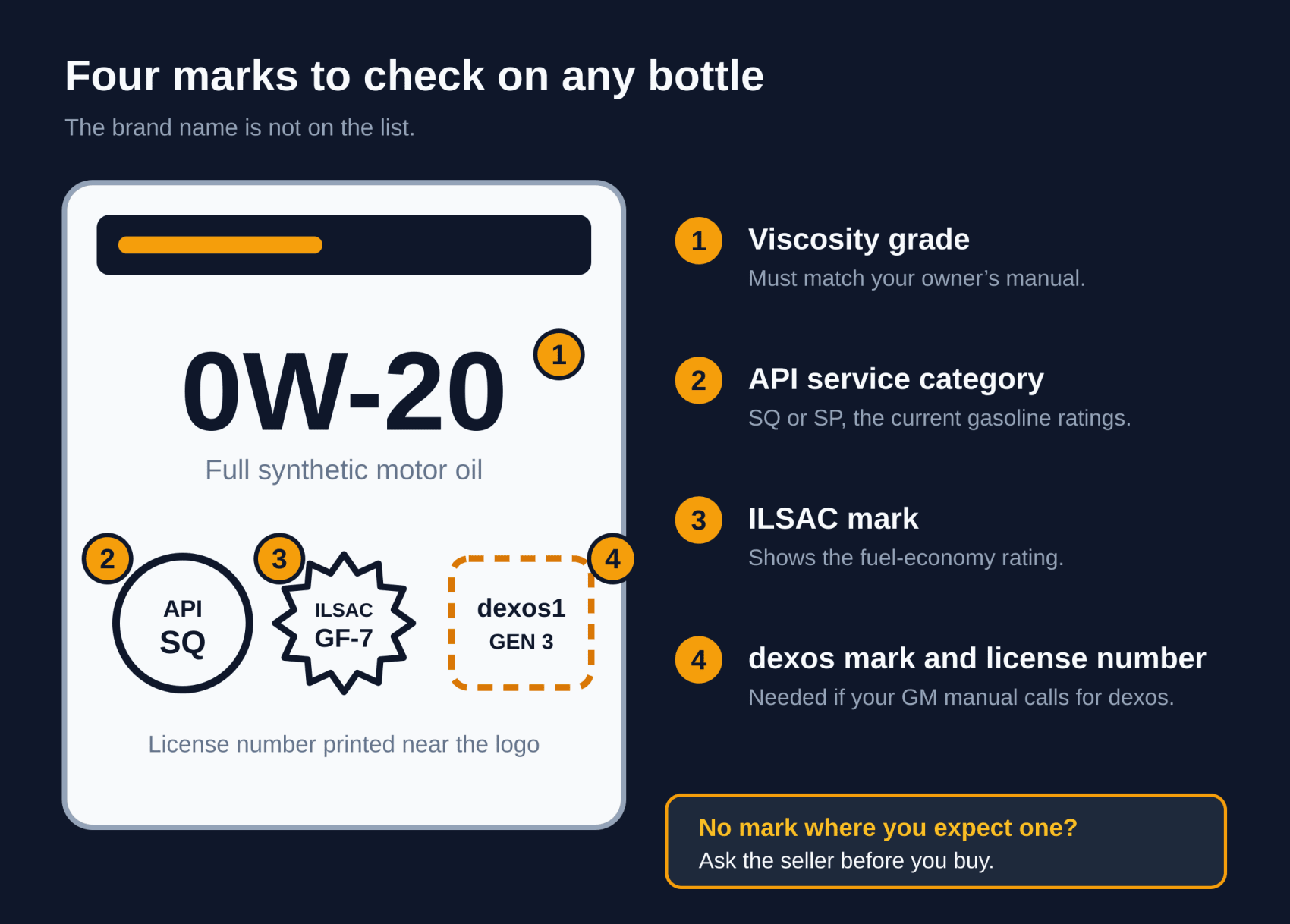
How to read a bottle in thirty seconds
There are four marks to look for. The viscosity grade must match your manual. The API service category, such as SQ or SP, shows the current gasoline rating. The ILSAC mark shows the fuel-economy rating. And, if your GM manual calls for it, the dexos mark and license number. No mark where you expect one means ask the seller before you buy, not after you pour.
The shelf at Sauto Mobils
Now to what's actually on the shelf. Sauto Mobils carries the Pennzoil line in its motor oil category, and here's what we can and can't tell you about it.
The Platinum line. The Pennzoil Platinum 0W-20, 5W-20 and 5W-30 are listed in 946 mL bottles at $6.00 each. The 10W-30 is $6.00 in the same size, or $17.98 in a 5-liter jug. Shops can look at the 208-liter drums in 5W-20 and 5W-30, each $835.98. European-car owners have the Platinum Euro 0W-40 and 5W-40 at $6.00 a bottle.
The Ultra Platinum line. This is the tier Shell says it didn't alter. The Ultra Platinum 0W-40 is $6.50 a bottle, with a 208-liter drum at $934.98. There's also the Ultra Platinum 5W-20 in a 5-liter jug at $18.98, and quarts of 5W-20 and 5W-30 at $6.50.
What we can't tell you. The listings don't say which formulation is in a given container or whether a bottle carries the dexos mark. They're also sized differently from the U.S. one-quart and five-quart packs Shell refers to, with 946 mL bottles, 5-liter jugs and 208-liter drums, so don't assume Shell's statement about retail packs maps neatly onto them. If dexos matters for your vehicle, contact the team before you order. Call +1 (409) 797-7523 or email [email protected], and ask what's printed on the label of the stock you'd receive.
Not a Platinum customer? The Pennzoil High Mileage Synthetic Blend 5W-20 and 5W-30 5-liter jugs are $14.97. Note that these are synthetic blends, a different product from the Platinum High Mileage that Shell's notice refers to.
If you need to shop by the label
When the badge is the requirement, shop by the label, whatever the brand. For a 0W-20, compare the Mobil 1 Advanced Fuel Economy 0W-20 and the Castrol Edge 0W-20 5-quart jugs, both $17.98, and the Valvoline SynPower 0W-20 at $18.50. Each maker has described these oils as dexos-licensed in the past, but this story is exactly about how that can change, so check the mark on the bottle you'll actually receive. Valvoline's own change affects only certain bulk, tote and drum products, according to Lubes'n'Greases.
How wholesale ordering works
Sauto Mobils is set up for buyers who order in volume. Low-priced items carry a $500 minimum cart that can mix categories, as explained on the payment and ordering page, and volume tiers are listed on each product. The bulk pricing page covers business accounts, the shipping and delivery page covers delivery, and the returns and warranty page describes the 30-day return window, including the exclusion for hazardous materials. Because oil may be affected by that exclusion, confirm the label before you order, not after.
Questions the file raises
Is Pennzoil Platinum still a full synthetic?
Shell says Platinum and Ultra Platinum are still made with GTL base oil, and that the reformulated products use a blend of GTL and non-GTL base oils. It says they continue to meet the claims on their labels.
Is it safe to use in a GM vehicle?
That depends on what your manual requires. If it calls for dexos1 Gen 3, you need the license mark. If it only calls for API SP or SQ, check the label for that rating.
Why does Ultra Platinum still have the license?
Shell says it hasn't altered those formulations, which keep the same percentage of GTL base oil.
Does "made with natural gas" mean it's all GTL?
No. Shell says the wording changed in 2024 to describe how natural gas is used in the formulation. And the current Platinum reformulations explicitly include non-GTL base oils.
Will the dexos badge come back?
Nobody has said. Shell hasn't announced a timeline, and GM says it will review alternative formulations on their merits.
Can I use a different dexos-licensed brand?
Yes, if the bottle carries a current dexos license for the grade your manual calls for. The license, not the brand, is what counts.
Case status: open
Several lines are still being followed. Shell's partially restarted Pearl plant has repairs to its second train scheduled for the first quarter of 2027. GM has said it will keep reviewing alternative base oils submitted by blenders, and any change to a license would show up on the labels first. ILMA expects Group III supply to normalize only in mid to late 2027. In the meantime, the jug on your shelf might carry the badge or it might not, and the only way to know is to turn it around and look.
Sources
GM-Trucks: Shell Confirms Pennzoil Platinum Is No Longer dexos Licensed
JobbersWorld: Base Oil Shortage Puts dexos1 Approvals Under Strain
Planet X: The name on a jug of Pennzoil Platinum is no longer a reliable guide
Fuels & Lubes: GM rejects ILMA plea for dexos enforcement relief
Lubes'n'Greases: Valvoline Cuts Dexos Claim from Synthetic Oils
Hydrocarbon Processing: Shell partially restarts Pearl GTL plant