Shell Rotella 2027: New T4, T5, T6 Oils, CL-4 and FB-4
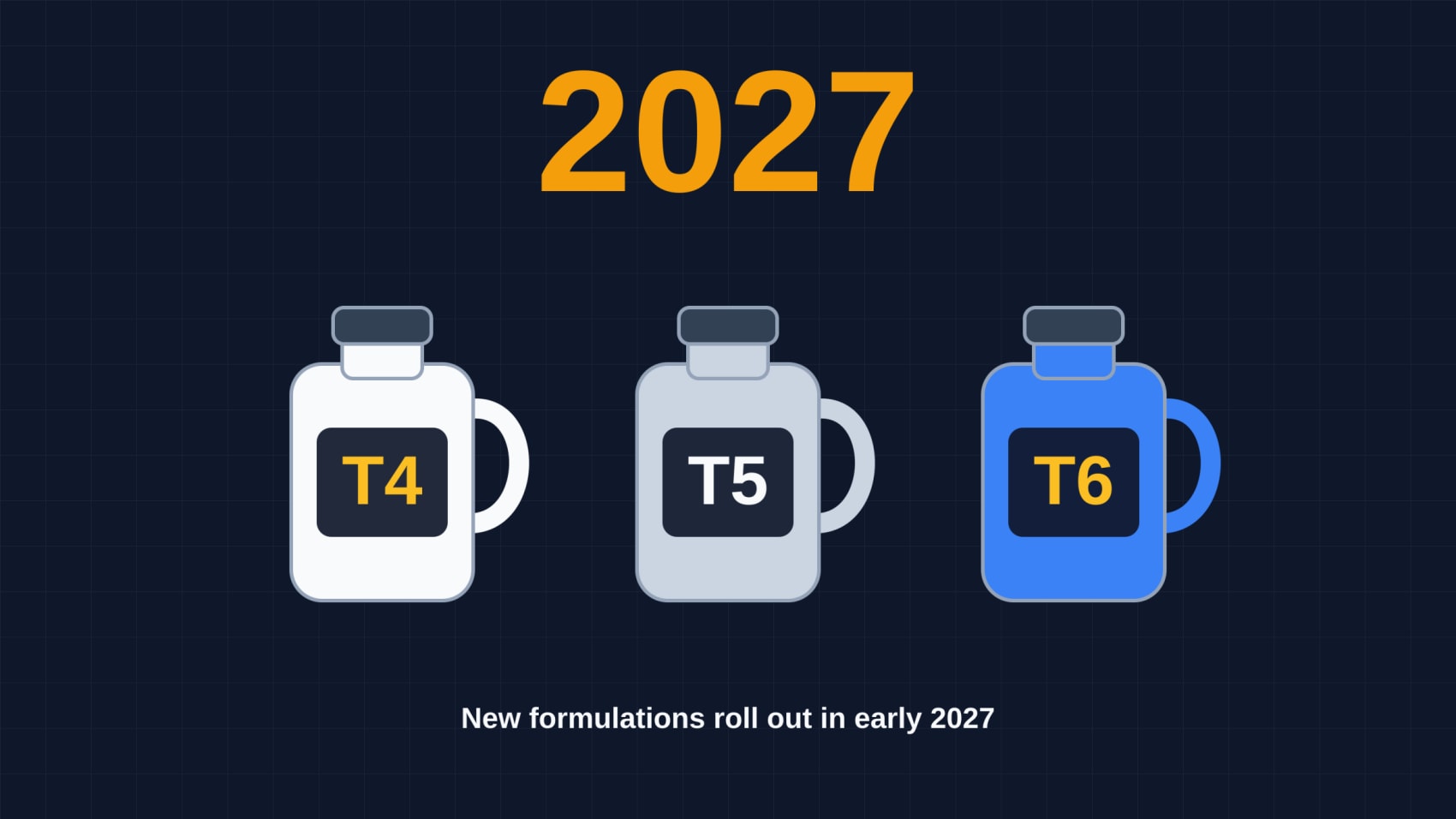
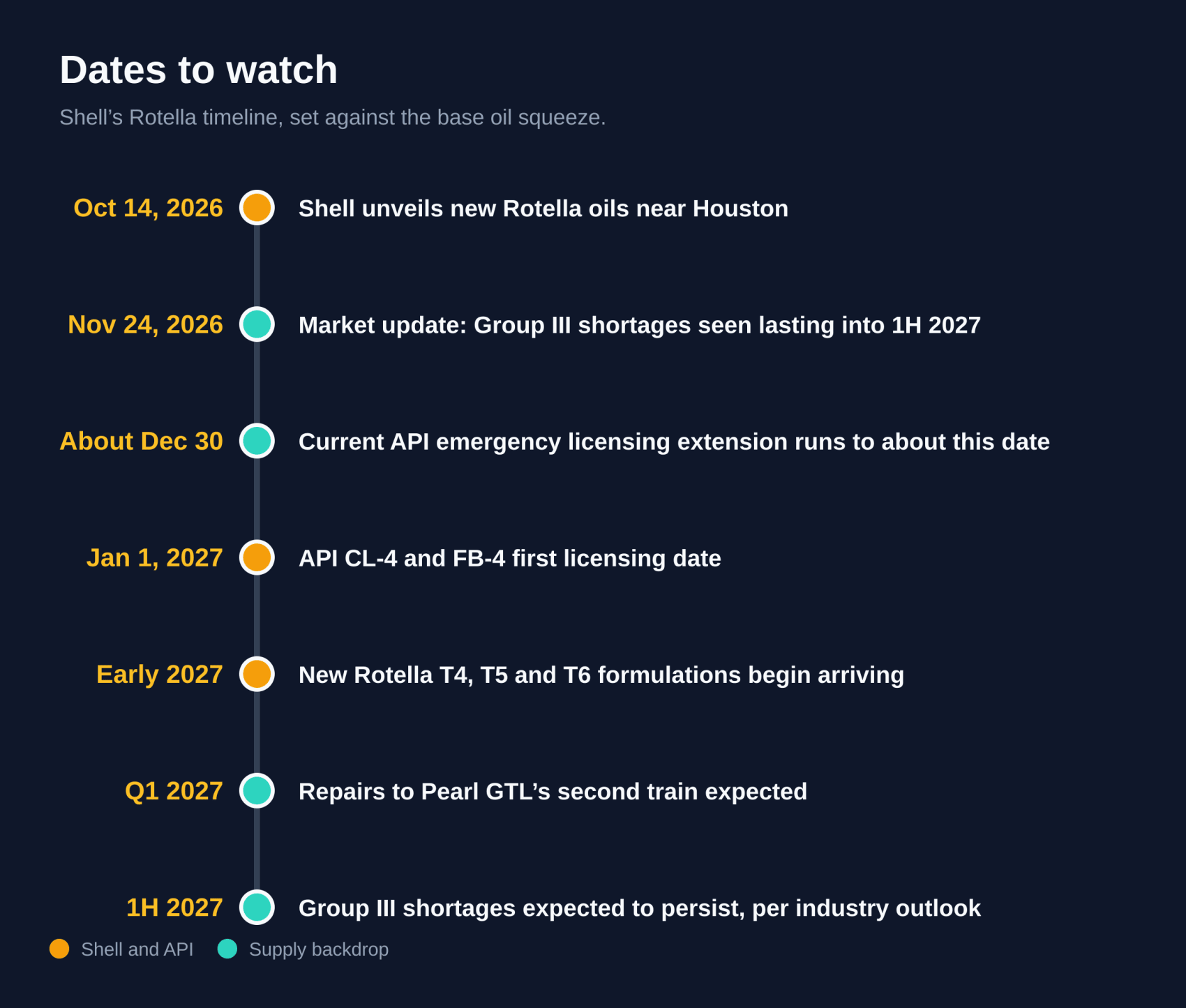
If you buy heavy-duty diesel oil for a living, the date to remember isn't a day on the calendar in November. It's January 1, 2027. That's the first licensing date for two new American Petroleum Institute categories, API CL-4 and API FB-4, and Shell has already said how it plans to meet them: new formulations of Rotella T4, T5 and T6, arriving in early 2027, with longer warranty coverage for T5 and T6.
This guide covers what Shell announced, what the new categories mean in plain English, how to read Shell's performance claims, and why the story is arriving in the middle of a tight Group III base oil market. We'll also show where the Rotella and Mobil Delvac shelf at Sauto Mobils fits for shops and fleets planning ahead.
What we know. Shell plans to begin rolling out new Rotella T4, T5 and T6 formulations in early 2027 to meet API CL-4 and FB-4, whose first licensing date is January 1, 2027. CL-4 is positioned as backward compatible with CK-4 applications. FB-4 is a lower-viscosity category for engines designed to use it. T5 and T6 get longer warranty limits. Meanwhile, a November 24 market update says Group III shortages may persist into the first half of 2027, and it's not yet clear how much Shell's partial Pearl GTL restart will help Rotella supply or pricing.
What Shell announced
Shell unveiled the lineup on October 14 at an event near Houston, as reported by Land Line and Fuels & Lubes. The new oils will be introduced starting in early 2027, in step with API's first licensing dates. Shell highlighted three formulations: Rotella T4 15W-40, T5 10W-30 and T6 10W-30. It also announced a redesigned T4 bottle and updated T5 and T6 labels that carry the new warranty claims, according to Pickup Truck Talk's report from the event.
Shell hasn't given an exact date for when bottles reach shelves, and the trade coverage uses the same wording: early 2027. That vagueness is normal. Licensing begins on January 1, blenders then need time to produce, ship and clear existing stock, and old and new labels will likely sit side by side for a while.
CL-4 and FB-4, explained without the jargon
The new categories come out of an industry development program called PC-12, and they replace the current heavy-duty standards. API CL-4 replaces CK-4, and API FB-4 replaces FA-4. The two do different jobs.
CL-4 is the continuation of the mainstream category. Shell describes it as backward compatible with CK-4 applications, meaning the new oils can be used in existing and older diesel engines where the oil meets the engine's requirements, according to Truck News. For most fleets running CK-4 oil today, that's the headline.
FB-4 is the specialist. It succeeds FA-4 and focuses on lower-viscosity formulations for engine platforms designed to balance fuel efficiency and durability. That's the key phrase: designed to use it. A lower-viscosity oil is not an upgrade for an engine that was built around a 15W-40, and the engine maker's guidance, not the label alone, decides whether it belongs in your engine. Fleet Maintenance notes that the new categories introduce lower-viscosity grades like 0W-20 and 5W-20 for heavy-duty diesel engines.
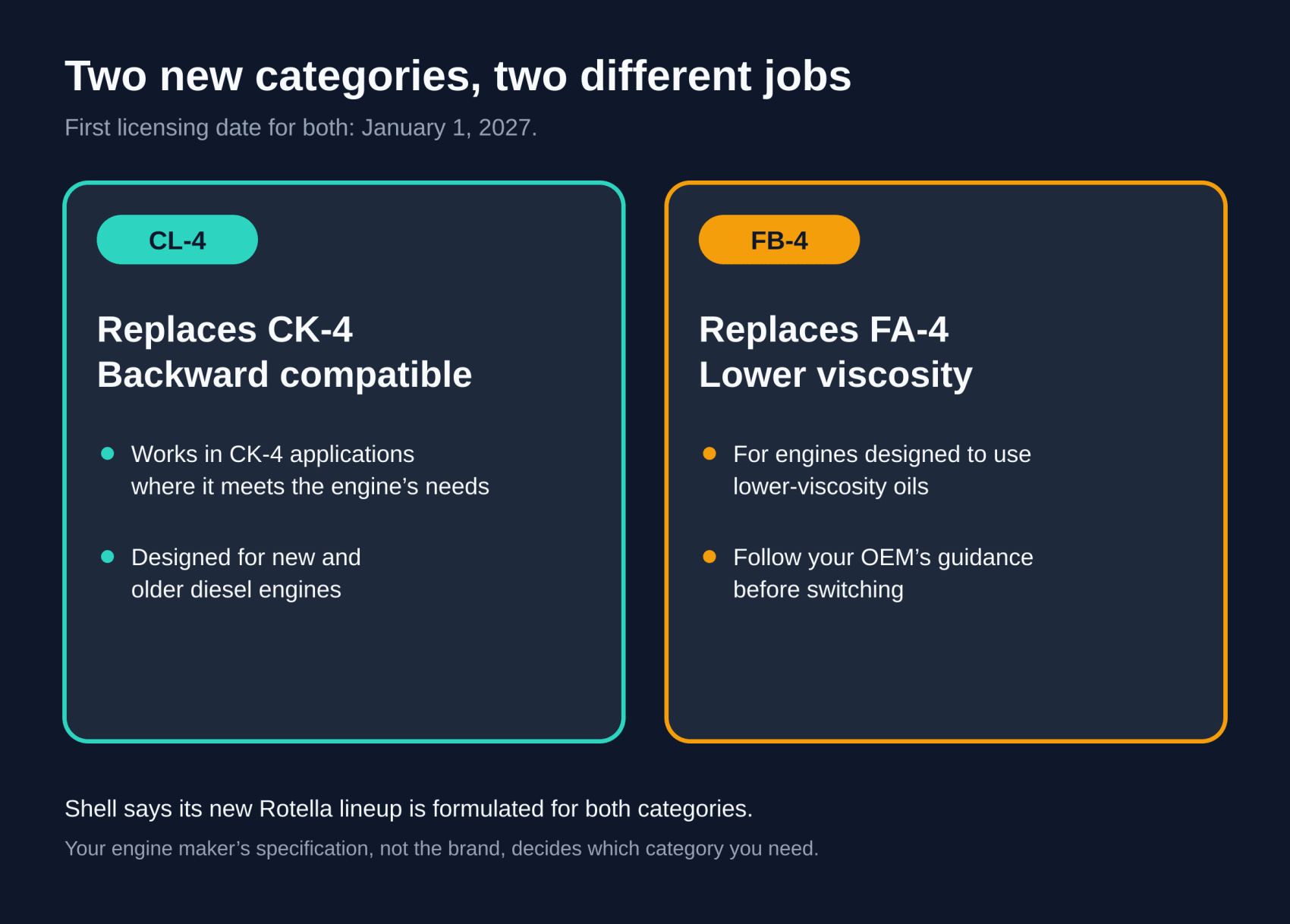
One honest wrinkle: the coverage doesn't spell out which of the three highlighted formulations carries which category. Shell says the new lineup is formulated for both CL-4 and FB-4, and the industry is still working through the details. JobbersWorld's PC-12 readiness survey found nearly six in ten respondents fully or mostly prepared, with unresolved OEM approvals and uncertain FB-4 demand among the open questions. Read each bottle's label for the category it actually claims.
The new T4, T5 and T6, and how to read Shell's numbers
Shell published performance claims for each tier, and they're worth reading with a skeptical eye, because they're measured against different baselines. Heavy Duty Trucking makes the point directly.
Rotella T4 15W-40: Shell reports 58 percent stronger deposit control than its previous CK-4 Rotella T4 15W-40. That's a comparison against Shell's own earlier product.
Rotella T5 10W-30: Shell says the formulation exceeds the API CL-4 oxidation and breakdown requirement by more than 90 percent, based on the T-13 oxidation test. That's a comparison against a specification limit, not an older product.
Rotella T6 10W-30: Shell reports an average of 66 percent more wear protection and 85 percent stronger resistance to deposits compared with API CL-4 requirements. Again, the baseline is the specification.
None of these numbers tells you how a bottle will perform in your particular truck, and they come from Shell's own testing. Shell says the formulations were validated through laboratory evaluations and fleet trials totaling millions of miles. As one example, Land Line reports on a truck that ran Shell's CK-4 T4 15W-40 for its first 370,000 miles and the new CL-4 T4 15W-40 for the next 400,000 miles, with Shell saying the tests showed cleanliness even at high mileage. It's one data point from a maker with an interest in the result, but it's the kind of evidence fleets will want to see more of.
The warranty story
Shell is pairing the new oils with longer limited-warranty limits for two of the three tiers, as Fuels & Lubes and Construction Equipment report:
T4 Triple Protection: stays at up to 10 years or 300,000 miles.
T5 Advanced Synthetic Blend: rises from 10 years or 300,000 miles to 12 years or 400,000 miles.
T6 Full Synthetic: rises from 15 years or 500,000 miles to 15 years or 600,000 miles.
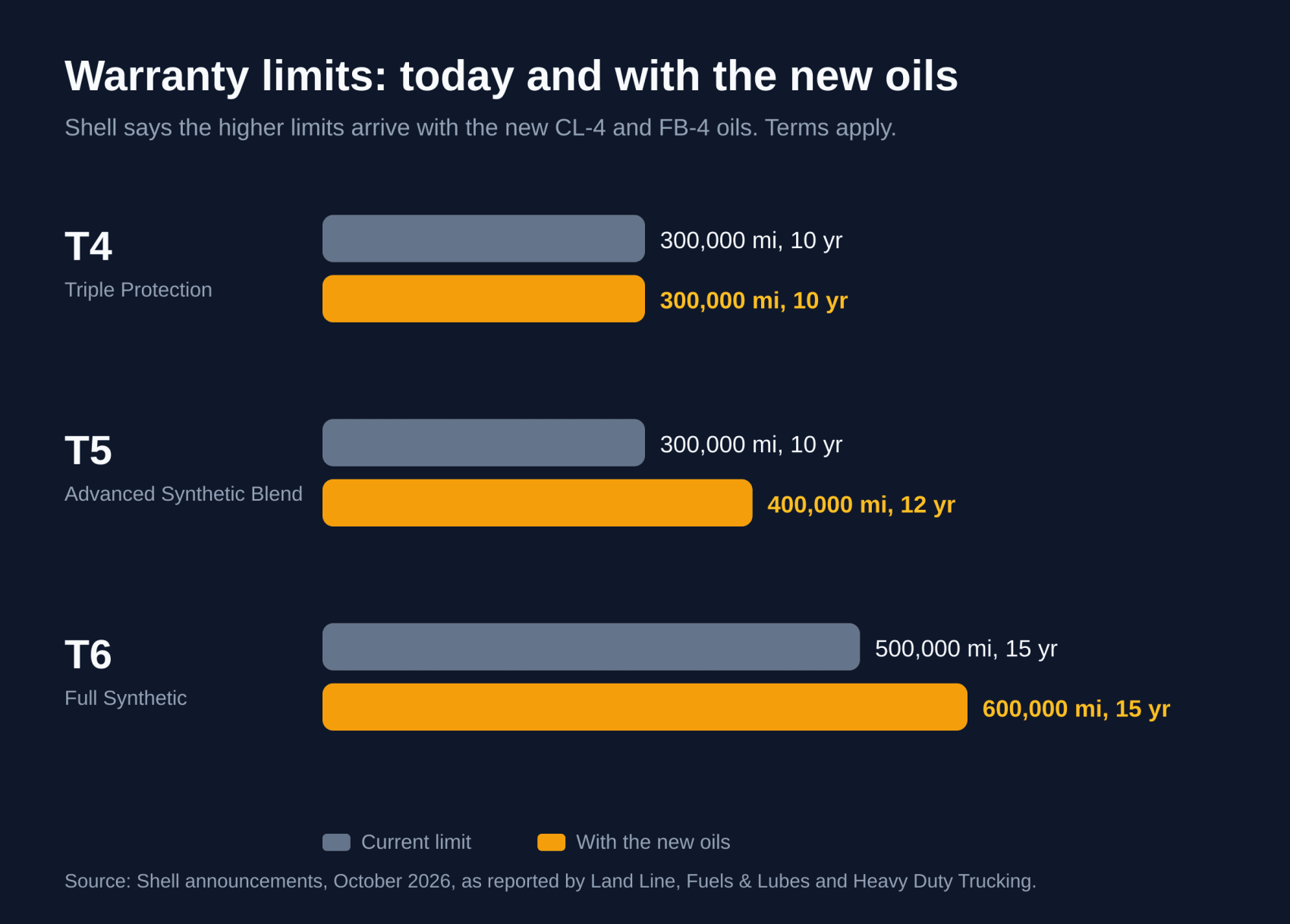
Shell says these limits arrive with the new CL-4 and FB-4 oils, so they're tied to the new formulations, not the bottles on shelves today. Warranty programs come with terms, and fleets should read them closely, keep purchase and service records, and confirm exactly which products and drain intervals qualify before relying on a number.
The supply backdrop: why this launch lands in a tight market
Here's where the announcement meets the wider market. A November 24 update from distributor Leahy-Wolf says Group III shortages are expected to last into the first half of 2027, and that base oil suppliers are still raising prices. It cites benchmark prices for Group III 4 cSt grades of roughly $3,500 to more than $4,700 per metric ton, and it notes that SK Enmove raised Group II+ and Group III base oil prices by 30 cents a gallon on November 1.
The Gulf supply picture is mixed. Some cargoes have left the Persian Gulf, but plants in Abu Dhabi, Bahrain and Qatar, including Shell's Pearl GTL, are still running below capacity. Shell has restarted one of Pearl's two processing trains, according to JobbersWorld and Reuters' report as carried by Hydrocarbon Processing. That lets Shell build limited inventory, and repairs to the second train are expected in the first quarter of 2027. But the same coverage is clear that base-oil shipments from the plant weren't confirmed, and that shipping still depends on regional security.
So what does that mean for Rotella? Honestly, it isn't clear yet, and anyone who tells you otherwise is guessing. Pearl is an important source of the GTL base oils used in premium synthetics, but a partial restart that builds inventory doesn't tell you how much product reaches blenders, or when. Two things are worth keeping apart. First, availability and price don't move together. Leahy-Wolf's earlier read was that supply should improve gradually through 2027, with availability improving before prices do. Second, finished-oil prices are already elevated. Shell's U.S. spring price increase was up to 25 percent, effective May 1, according to the same source's roundup of 2026 increases, and no new finished-lubricant increases had been announced for November, though costs underneath keep climbing.
Add the regulatory backdrop and you can see why blenders are being careful. API's emergency provisional licensing, which lets blenders adjust formulations when ingredients are unavailable, covers about 70 products and runs through repeated 90-day extensions, with the current one ending about December 30. When the new categories begin licensing in January, the industry will be managing a change in specification and a change in base oil sourcing at the same moment.
What to do: a practical plan for shops and fleets
You don't need to panic and you don't need to wait. A few steps cover most situations.
1. Audit your specifications. List every engine you service and the API category and viscosity each one's maker requires. Most fleets today run CK-4 oils, and a smaller group runs FA-4 oils in engines designed for them.
2. Treat CL-4 as the easy path and FB-4 as the careful one. CL-4 is positioned as backward compatible with CK-4, so existing CK-4 engines have a straightforward upgrade route once OEM guidance confirms it. FB-4 oils should only go into engines approved to use them, and a thinner oil is never a substitute for the grade your manual lists.
3. Don't strand stock. Current CK-4 oils don't expire on January 1. Buying a sensible amount ahead is reasonable in this market, but avoid stockpiling more than you can use within your storage and shelf-life limits.
4. Keep records. Warranty claims, oil analysis and drain-interval decisions all depend on knowing exactly which product went into which engine on which date. That matters more than usual when formulations are changing.
5. Use oil analysis when anything changes. If a product or formulation changes mid-year, a sample is the cheapest way to confirm it's still protecting the engine.
6. Read every label. In a year when formulations have shifted across the industry, the category and approvals printed on the bottle in your hand are the only reliable guide.
The Rotella shelf at Sauto Mobils today
Sauto Mobils carries Shell Rotella across conventional, synthetic blend and full synthetic oils. These are current listings, and we can't tell you when new-formulation stock will appear, so confirm the label before you order. If an API category matters for a specific engine, ask the team what's printed on the stock you'd receive.
Full synthetic (T6). The Rotella T6 5W-40 comes as a quart at $5.00, a gallon at $17.50, a 2.5-gallon jug at $39.99 and a 5-gallon pail at $76.00. The T6 15W-40 is priced the same, in gallon, 2.5-gallon and 5-gallon sizes. For mixed fleets, there's the T6 5W-30 gallon at $17.50, and for the coldest climates the Full Synthetic Heavy Duty 0W-40 at $17.50. A general Rotella T6 gallon listing is $17.50, so confirm the grade on its page.
Synthetic blend. The Rotella Synthetic Blend 15W-40 is $14.49 a gallon, with a 2.5-gallon jug at $33.49 and a 5-gallon diesel pail at $65.00. Two 10W-30 blends, the Heavy Duty and the standard, are $14.49 a gallon. A caution: a 10W-30 is a lower-viscosity heavy-duty grade, so don't use it in a diesel unless your manual calls for it.
Conventional. The Rotella Conventional 15W-40 comes as a quart at $3.75, a gallon at $11.49, a 2.5-gallon jug at $27.50 and a 5-gallon pail at $49.99. There's also 10W-30 in a gallon at $11.49 and a quart at $3.75, and single grades in 30W (also a 5-gallon pail at $49.99) and 40W at $11.49 a gallon.
The pail math
Container size matters more than tier in a tight market. The T6 5W-40 pail works out to $15.20 a gallon against $17.50 for a single gallon, the synthetic blend pail to $13.00 against $14.49, and the conventional pail to $10.00 against $11.49. For a shop that goes through several gallons a week, the pail is the obvious buy.
How Rotella compares with Mobil Delvac
Fleets often shop both. The Mobil Delvac 1300 Super 15W-40 is $9.99 a gallon, with a 5-gallon pail at $49.99. The Delvac Full Synthetic 15W-40 is $15.99 a gallon, and the Delvac 1 ESP 5W-40 pail is $85.00. Whichever brand you buy, the approvals on the label and in your engine maker's guidance matter more than the name.
Ordering terms
Sauto Mobils is built for buyers who order in volume. Low-priced items carry a $500 minimum cart that can mix categories, as the payment and ordering page explains, and volume tiers appear on each listing, with the bulk pricing page covering business accounts. The shipping and delivery page describes delivery, and the returns and warranty page covers the 30-day window, including the exclusion for hazardous materials, so ask about oil before you order. The team is in Little Rock, Arkansas, at +1 (409) 797-7523 or [email protected], and the whole shelf is in the motor oil category.
Questions fleets are asking
When will the new Rotella oils be available?
Shell says early 2027, in step with API's January 1, 2027 first licensing date. No exact date has been announced.
Can I use CL-4 oil in a CK-4 engine?
Shell describes CL-4 as backward compatible with CK-4 applications where the oil meets the engine's requirements. Check your engine maker's guidance.
Can I use an FB-4 oil in any diesel?
No. FB-4 is a lower-viscosity category for engines designed to use it, so follow your manual.
What changes in the Rotella warranty?
T4 stays at up to 10 years or 300,000 miles. T5 rises to 12 years or 400,000 miles, and T6 to 15 years or 600,000 miles, according to Shell's announcement.
Do the longer warranty limits apply to the Rotella on the shelf now?
Shell ties them to the new CL-4 and FB-4 oils, so assume not, and read the terms for each product.
Will Rotella prices rise in 2027?
Nobody has announced a change. The base oil market is still tight, and Pearl's partial restart hasn't been shown to change supply or pricing yet.
Should I stock up before January?
A sensible cushion makes sense, but current CK-4 oils remain valid, so avoid buying more than you can store and use.
Does the Pearl GTL restart mean Rotella supply is improving?
Not necessarily. Shell has restarted one train and can build limited inventory, but base oil shipments weren't confirmed in the reports we read.
January 2
There's a quiet moment coming. On January 2, the first licenses will have been issued, the first labels will have been printed, and somewhere a fleet manager will walk past a shelf and notice that a familiar jug looks slightly different. The new category will be printed on the label. The warranty claim will be on the side. And for the first few weeks, the old bottle and the new bottle will sit next to each other, the same brand and the same family but not quite the same oil. Reading both labels will be the whole job.
Sources
Truck News: Shell Rotella targets fuel savings, longer service intervals with new engine oils
Fuels & Lubes: Shell Rotella unveils API CL-4 and FB-4 heavy-duty engine oils
Fleet Maintenance: How Shell Rotella's new PC-12 oils address diesel engine wear
Pickup Truck Talk: The research behind Shell Rotella CL-4/FB-4
Hydrocarbon Processing: Shell partially restarts Pearl GTL plant in Qatar