Valvoline Earnings: Fiscal 2026 Results & What They Mean
On November 19, a company that has spent 40 years changing other people's oil told investors it had its best year yet. Valvoline earnings for the fourth quarter and fiscal 2026 arrived with a headline built to be quoted: annual system-wide store sales topped $4 billion, and sales at established stores grew for the 20th consecutive year. By the end of the trading day, Valvoline stock had jumped, by roughly 10 percent in some reports and almost 13 percent in others.
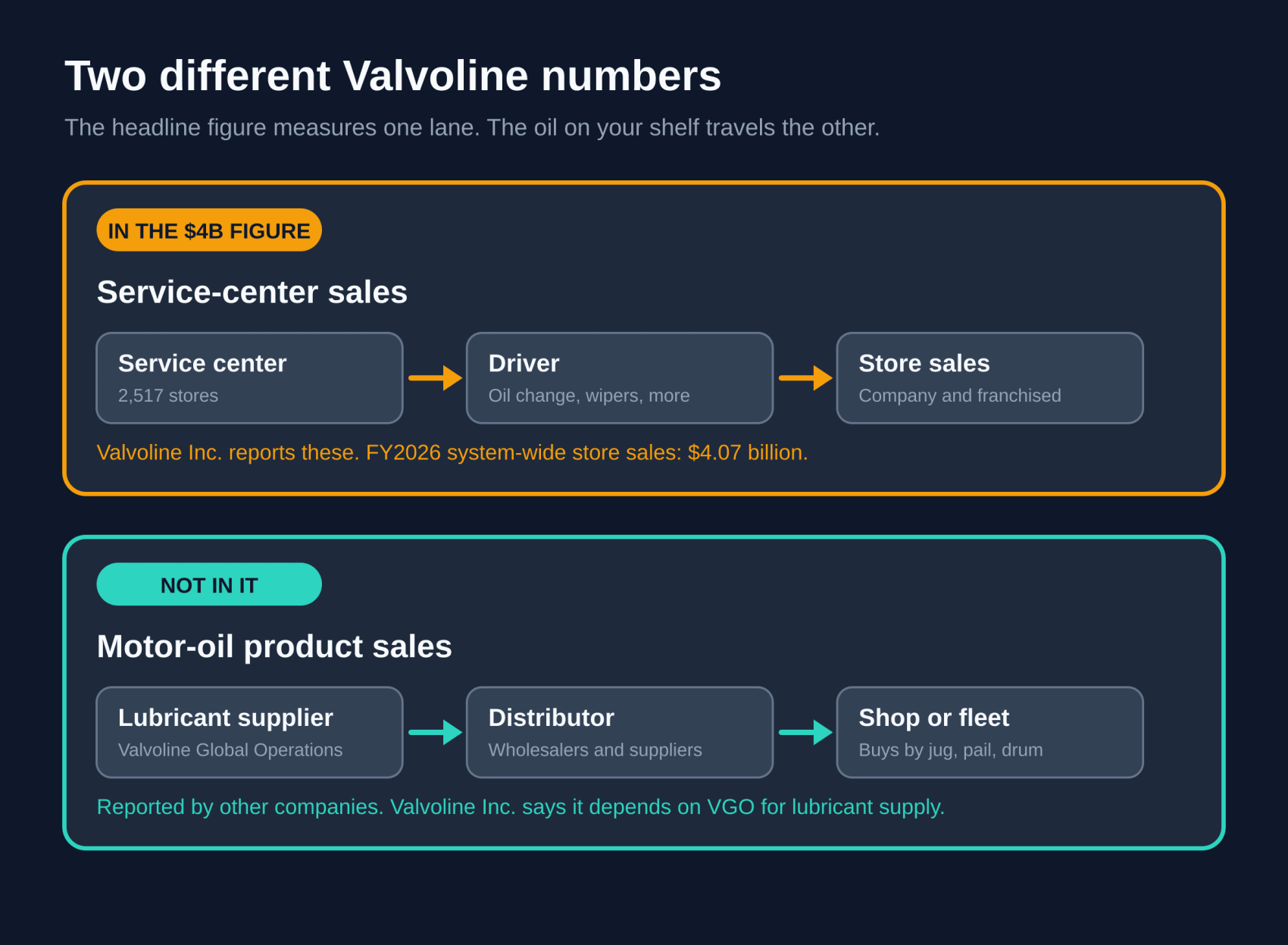
Here's the catch, and it's the reason this article exists. Those are service-center sales, not motor-oil product sales. If you sell oil, buy oil by the pail, or run a shop that stocks it, the $4 billion doesn't measure your world. It measures the world of the person who drives to a bay, stays in the car, and hands over the keys. Both worlds carry the same name on the label, and they're easy to confuse. This guide walks through the Valvoline fiscal 2026 results, explains what each number covers, and then shows where the Valvoline products on the shelf at Sauto Mobils fit into the picture.
The scoreboard, in plain English
Start with what the company reported, using its own Business Wire release for the year ended September 30, 2026:
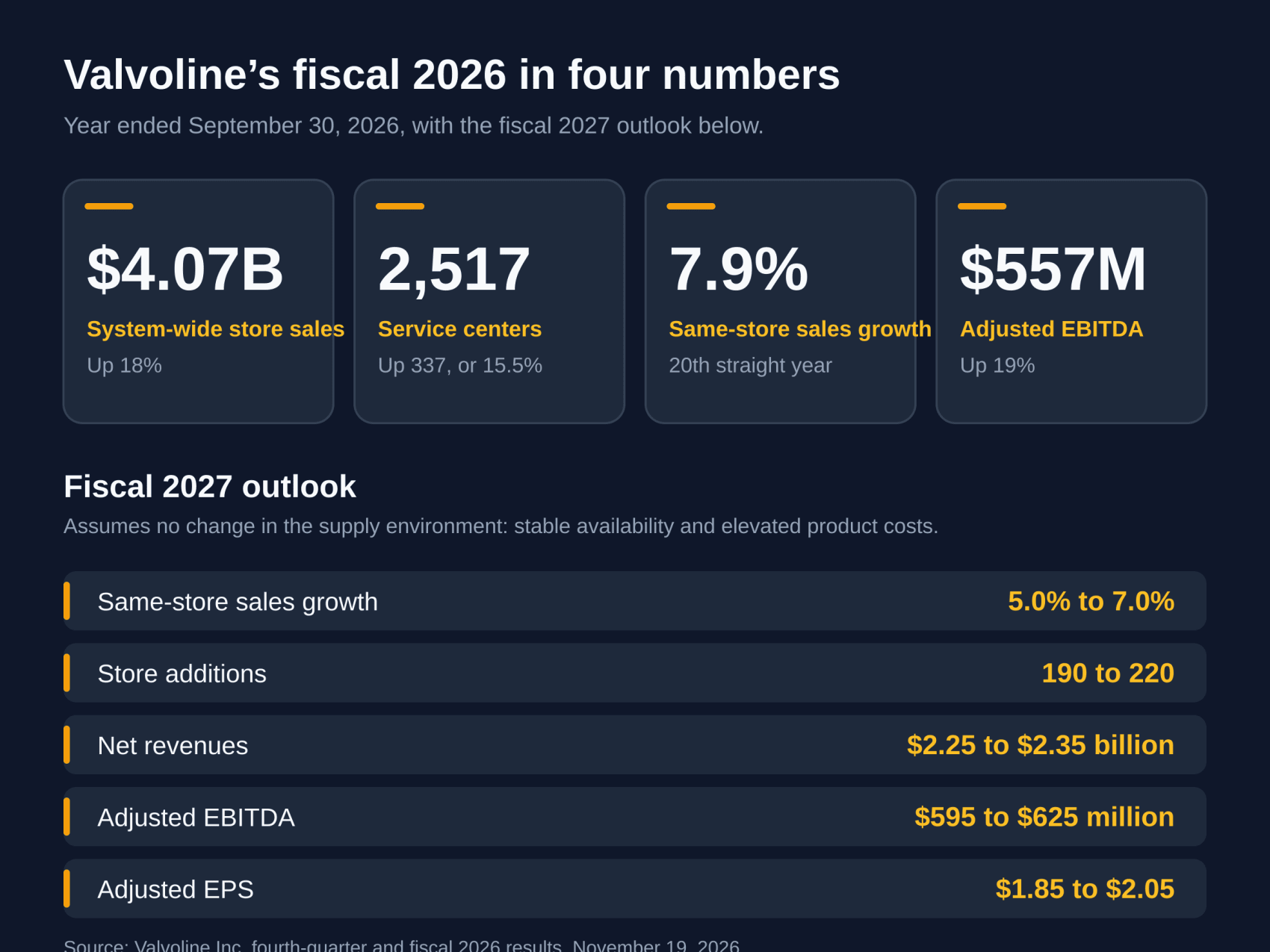
System-wide store sales came to about $4.07 billion, up 18 percent.
Net revenues were about $2.06 billion, up 21 percent.
The network grew to 2,517 service centers, an increase of 337, or 15.5 percent.
Same-store sales rose 7.9 percent for the year and 9.4 percent in the fourth quarter, marking the 20th consecutive year of growth.
Adjusted EBITDA rose 19 percent to about $557 million.
Adjusted earnings per share were $1.76, ahead of the company's own outlook range of $1.70 to $1.75.
That's a strong year by any measure. But two of those numbers look like they should match and don't: $4.07 billion in store sales against $2.06 billion in revenue. Understanding that gap is the key to reading everything else correctly.
Number one: why $4 billion becomes $2 billion
The Valvoline Instant Oil Change network has two kinds of stores. Some are company-operated, and Valvoline books every dollar of their sales as its own revenue. Others are franchised, owned by independent operators who pay Valvoline royalties and fees. In the release's breakdown, company-operated stores account for roughly $1.85 billion of system-wide store sales and franchised stores for about $2.22 billion.
Here's the part that matters. A franchised store's sales belong to the franchisee, and Valvoline recognizes only the royalties and fees it collects. So the $4.07 billion figure counts everything customers spent across the whole system, while the $2.06 billion figure is what Valvoline itself reported as revenue. Neither one is the amount of motor oil anybody sold. Both are measures of services: oil changes, filters, wipers, fluids, and the labor that goes with them.
A useful test for any earnings headline. Ask who the customer is. At a service center, the customer is the driver, and the product is a service. At a wholesale counter, the customer is a shop, fleet or reseller, and the product is a quart, a pail or a drum.
Number two: twenty years of same-store growth
The phrase Valvoline same-store sales sounds technical, but the idea is simple. It compares what stores that have been open for at least a year sold this year with what the same stores sold last year. It strips out the effect of simply opening more locations, which is why investors treat it as the cleanest read on whether customers keep coming back.
By that standard, the Valvoline fiscal 2026 results are unusually consistent. Growth of 7.9 percent for the year and 9.4 percent in the fourth quarter extends a run that the company says now stretches to 20 consecutive years. Preventive maintenance is steady work. Cars keep needing oil changes whether the economy is booming or wobbling, and the average U.S. vehicle is nearly thirteen years old, according to S&P Global Mobility. Older cars mean more maintenance.
There's one soft spot worth knowing about. On the earnings call, as MarketBeat's highlights report, executives said growth was softer at stores in lower-income areas, largely because of slower new-customer acquisition, and that the outlook assumes the softness continues.
Number three: 2,517 stores and a big acquisition
The network didn't grow by 337 stores on its own. In December 2025, the company bought Valvoline Breeze Autocare, the owner of the Oil Changers shops, a deal financed with significant new debt. The earnings call suggests it has paid off. Valvoline said Breeze performed ahead of expectations, with revenue and EBITDA contributions above the company's outlook, and it converted 28 acquired stores to the Valvoline brand during the year, 16 of them in the fourth quarter.
Growth now depends heavily on the Valvoline franchise model. For fiscal 2027, the company plans to add 190 to 220 stores, with franchise locations expected to account for roughly half of them. Franchising spreads the cost of building out the network, but it also means more of the system's sales belong to someone else, which brings us back to the $4 billion versus $2 billion gap.
Where the oil comes from: the part the headline leaves out
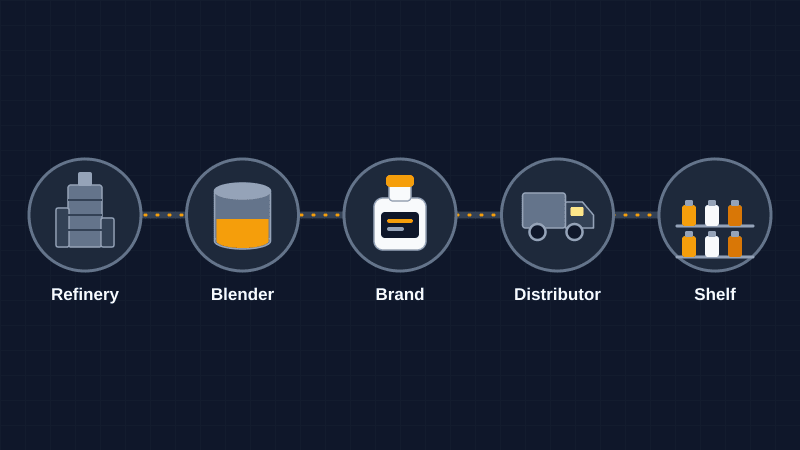
Now to the supply side, which is where this story touches the shelf. The release is blunt about the company's dependence on others for the one thing every oil change needs. Valvoline Inc. says it depends on Valvoline Global Operations, the lubricant business it sold in 2023, for substantially all of its lubricant supply, and it operates under a brand-sharing arrangement with that company. Put simply, the service centers and the products that carry the Valvoline name are now run by different companies.
That's why the Valvoline 2027 outlook comes with a very specific assumption. In CEO Lori Flees's words, the outlook assumes no change in the supply environment, meaning stable availability and continued elevated product costs. That isn't a throwaway line. It's the same pressure rippling through the whole industry, which we've covered in earlier reports on the base oil squeeze in Lubes'n'Greases' running coverage.
The pressure showed up in the numbers. Using the income statement in the release, fourth-quarter cost of sales rose roughly 30 percent while net revenues rose 22 percent. By our arithmetic, that pushed the quarter's gross margin to about 35 percent from about 39 percent a year earlier. The company's full-year adjusted EBITDA margin held near 27 percent, but the fourth-quarter figure slipped. Analysts at Panabee noted that the outlook depends in part on Valvoline maintaining pricing or service mix while product costs stay high.
There's a second supply wrinkle on the product side. As Lubes'n'Greases reported, Valvoline has removed GM dexos labeling from certain full synthetic products sold in bulk, tote and drum containers, while its products in one-quart and five-quart containers remain dexos-approved while supplies last. We looked at the same pattern when Shell reformulated Pennzoil Platinum. The lesson for anyone buying oil is the same either way: read the label on the bottle in your hand.
Reported versus adjusted: the earnings footnote worth reading
Wall Street watches adjusted numbers, and the company's adjusted results were strong. Its reported results, however, look quite different. Reported earnings per share for the year were $0.69, down 59 percent, against adjusted earnings of $1.76, up 11 percent. The difference comes from items the company excludes from its adjusted figures, such as acquisition-related costs and other one-time charges.
The distinction matters because the market clearly sided with the adjusted view. Benzinga noted the stock rose by almost 13 percent after the report, which also included a refinancing that extended the debt maturity profile and an increase in the share repurchase authorization to $500 million. Seeking Alpha put the gain closer to 10 percent. One closing detail, as Finsee's review points out: after borrowing heavily for Breeze, Valvoline froze buybacks until net debt fell back into its target range, so the first buyback in the next quarter would be a signal worth watching.
The fiscal 2027 outlook, line by line
The Valvoline 2027 outlook calls for system-wide same-store sales growth of 5 to 7 percent, 190 to 220 store additions, net revenues of $2.25 to $2.35 billion, adjusted EBITDA of $595 to $625 million and adjusted earnings per share of $1.85 to $2.05. Growth is expected to slow somewhat, partly because Breeze stops flattering the year-over-year comparison after December. The company also expects margin pressure to continue while product costs stay high.
What this means at the wholesale counter
Here's where the headline and the shelf finally meet. The Valvoline-branded oil that shops, fleets and resellers buy by the case doesn't show up in these store numbers. It moves through product channels, and prices there follow the same base oil costs the earnings release warns about. The practical takeaway is to understand what's on your shelf, buy the container size that makes sense, and keep an eye on the label.
Valvoline synthetic oil for modern engines
The Valvoline synthetic oil lineup at Sauto Mobils starts with the SynPower range. The SynPower 0W-16 comes in a 5-quart jug at $18.50 and a 1-quart bottle at $5.75, for engines that specify that thin grade. The SynPower 0W-20 and 5W-20 jugs are the same $18.50, with matching 0W-20 and 5W-20 quarts, and the SynPower 5W-30 jug covers the classic grade.
A step up in positioning is the Restore & Protect line, built for engines that have picked up some wear. The 0W-20 jug, 5W-20 jug and 5W-30 jug are $19.50 each, with 0W-20 and 5W-20 quarts at $6.00.
Valvoline MaxLife for high-mileage engines
Valvoline MaxLife is the brand most people think of when the odometer gets high. The full-synthetic version, Valvoline Full Synthetic High Mileage with MaxLife Technology, comes in 0W-20, 5W-20 and 10W-30 5-quart jugs at $19.00, plus quarts of 0W-20, 5W-20, 5W-30 and 10W-30 at $6.00.
On a tighter budget, the MaxLife synthetic blend range is the value pick. The 10W-30 and 5W-20 jugs are $15.49, and the quarts of 10W-30, 5W-20 and 5W-30 are $4.50.
The simple math of container size
Whichever line you choose, the jug beats the quart. SynPower works out to about $3.70 a quart in the jug against $5.75 for a single bottle. Restore & Protect is about $3.90 against $6.00, full synthetic MaxLife about $3.80 against $6.00, and the MaxLife blend about $3.10 against $4.50. For a shop doing a dozen oil changes a week, that gap adds up quickly.
Conventional and motorcycle oils
Simpler engines have simpler options. There's a Valvoline Conventional 20W-50 jug at $19.00 and a quart at $5.00, plus a 4-stroke motorcycle oil in 10W-40 at $4.25. If your motorcycle has a wet clutch, check the label for the right JASO rating before pouring.
Drivetrain fluids, grease and brake fluid
The Valvoline name goes well beyond the oil pan, and a service business knows that every visit touches several fluids. At the wholesale counter, the same logic helps a shop build a mixed order that reaches the minimum cart. For automatic transmissions, there's the Full Synthetic ATF for Dexron VI at $7.50, the MaxLife Full Synthetic Multi-Vehicle ATF at $6.50, the Conventional Dexron III-H and Mercon at $5.00, the Mercon V at $6.50 and the Type F at $5.25. Manual-gearbox owners can use the Conventional M/T Fluid at $5.50, and heavier-duty axles have the FlexFill Full Synthetic Gear Oil 75W-140 at $9.99 or the SynPower 75W-140 GL-5/GL-4 at $9.49. Two maintenance products round out the shelf: the MaxLife Transmission Stop Leak at $7.50 and the MaxLife Power Steering Fluid at $5.50. Browse the full transmission fluid category for more.
Equipment owners can look at the Conventional Hydraulic Oil 46W in a 5-gallon pail at $57.49 and the Multi-Purpose Fluid 10W-30 at $65.00. Grease comes in a 14.1-ounce cartridge at $4.50 or a 35-pound pail at $109.00. And the 32-ounce DOT 3/DOT 4 brake fluid at $7.00 covers two ratings in one bottle. See the whole brake fluid category if you're stocking more than one type.
How to buy Valvoline at wholesale from Sauto Mobils
The terms are written down. Low-priced items carry a $500 minimum cart that can mix categories, which suits shops that order oil, transmission fluid, grease and brake fluid together. The payment and ordering page explains the rule, and volume tiers appear on each listing, with the bulk pricing page covering business accounts. Delivery options and timelines are on the shipping and delivery page, and the returns and warranty page describes the 30-day window, including the exclusion for hazardous materials, so ask about oil before you order. If a GM dexos approval matters for a vehicle you service, ask the team what's printed on the label of the stock you'd receive. You can reach them at [email protected], and the full motor oil category is open any time.
How to read the next Valvoline earnings release
Earnings season rewards people who know which line to read first. When the first quarter of fiscal 2027 arrives, here's what's worth checking, in this order:
Same-store sales growth. Is it holding inside the 5 to 7 percent range, and is the lower-income softness spreading?
Gross margin. Did it stabilize, or did product costs keep pressing?
Supply commentary. Does the company still assume no change in the supply environment?
Store additions. Is the 190 to 220 plan on track, and how many are franchised?
Buyback spending. Does Valvoline resume repurchases, as Finsee suggests would signal that debt is back in range?
Breeze conversions. How many more stores have been converted to the Valvoline brand?
Questions readers are asking
Does the $4 billion figure include motor oil sold to shops and distributors?
No. It measures sales at service centers, company-operated and franchised, so it reflects services sold to drivers, not oil sold wholesale.
Why is Valvoline's revenue about half its store sales?
Revenue includes sales at company-operated stores plus royalties and fees from franchised stores. Franchised stores' own sales count toward system-wide store sales but not toward Valvoline's revenue.
What does same-store sales growth measure?
Sales at stores open for at least a year, compared with the same stores a year earlier. It filters out the effect of simply opening more locations.
What is Valvoline Breeze Autocare?
It's the owner of the Oil Changers shops, bought in December 2025. Valvoline has been converting acquired stores to its own brand, with 28 converted in fiscal 2026.
How big is the Valvoline franchise network?
Of 2,517 stores at year end, roughly half are franchised, and franchisees are expected to account for about half of the 190 to 220 stores planned for fiscal 2027.
Is the Valvoline MaxLife line synthetic?
Both versions exist. There's a full synthetic MaxLife and a MaxLife synthetic blend, so check the product name and label.
Will Valvoline raise prices?
The company says the outlook assumes elevated product costs continue. It hasn't announced specific price changes in the release.
The next number
The next test comes when Valvoline reports its first quarter of fiscal 2027, the first full period under the outlook it laid out this week. The question isn't whether people will keep getting oil changed. It's whether the cost of what goes into the engine stays high enough to keep squeezing the margin on the way. The base oil market, the supply agreements behind the brand and the price on the shelf are all moving at once, and a 20-year growth streak doesn't answer any of that by itself. The next release, and the shelf, will.
Sources